
The way devices work today is very different from the past. With the rise of the Internet of Things (IoT), devices are no longer working alone; they're constantly connected and sharing information. In factories, machines monitor performance in real time. In hospitals, smart devices help teams respond faster. At home, connected products quietly make everyday tasks easier.
As this network of devices continues to grow, managing everything the traditional way becomes harder and less effective. There’s simply too much data and too many connections to handle manually. That’s where agentic AI plays a key role. By enabling autonomous decision making, it helps IoT systems think, act, and adapt on their own, making operations smarter and more efficient.
The numbers clearly show how quickly this shift is happening. In North America alone, the autonomous AI-driven smart homes and IoT market is already valued at USD 6.1 billion. On a global scale, revenues are expected to soar to USD 138.7 billion by 2034, growing at an impressive 25.6% CAGR.
This rapid growth signals something bigger than market expansion. It reflects a move toward truly intelligent systems, where devices do more than just stay connected. They can sense what’s happening around them, make decisions in real time, and take action with very little human involvement.
What is Agentic AI in IoT?
Agentic AI goes beyond basic automation. It refers to intelligent software that can think through situations, make decisions, and take action on its own, without needing constant human direction. Within IoT environments, this transforms devices from simple data collectors into active participants. They don’t just sense their surroundings; they interpret what they observe, learn from it, and respond in ways that make sense in real time.
For example, a smart thermostat doesn’t simply follow a schedule. It understands how people use a space and adjusts the temperature to balance comfort and energy efficiency. In industrial settings, sensors can detect subtle changes in machine behavior, recognize early warning signs, and trigger alerts or corrective actions before a small issue becomes a serious failure.
Unlike traditional IoT systems that rely heavily on centralized control, agentic AI allows devices to operate independently while still coordinating with one another. This shift, from waiting for instructions to acting proactively, makes IoT networks faster, more resilient, and more reliable. As a result, homes become more comfortable, cities more responsive, and industries more efficient and smoothly run.
Why Does IoT Need to Operate Independently?
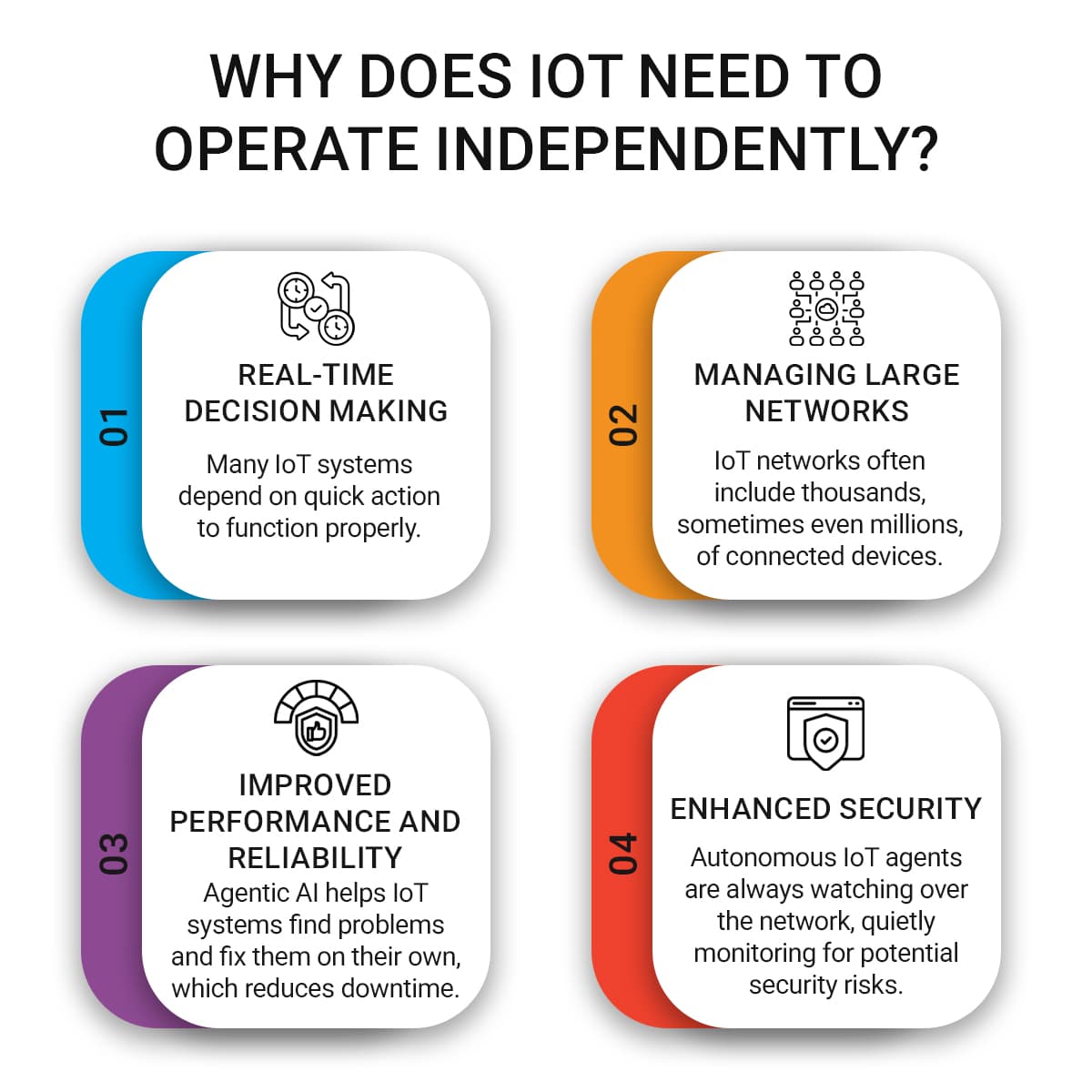
Real-Time Decision Making
Many IoT systems depend on quick action to function properly. They need to spot unusual activity, adjust device settings on the spot, or resolve small issues before they turn into bigger problems. Timing matters, and delays can make a real difference.
Agentic AI removes the need for devices to wait for instructions from a central system. Instead, they can analyze data instantly and act on their own. This enables faster responses, reduces delays, and helps IoT systems run smoothly and reliably.
For example, in a smart building, IoT sensors monitor temperature and energy use in real time. When a room starts overheating, agentic AI adjusts the cooling immediately without waiting for central instructions. This fast, independent action prevents larger issues, saves energy, and keeps the system running smoothly.
Managing Large Networks
IoT networks often include thousands, sometimes even millions, of connected devices. Trying to manage all of them manually, or with simple automation, quickly becomes overwhelming. Agentic AI changes this by allowing devices to operate independently. They can make decisions, respond to issues, and solve problems on their own, without requiring constant human monitoring.
Improved Performance and Reliability
Agentic AI helps IoT systems find problems and fix them on their own, which reduces downtime. For example, if one sensor stops working, the system can automatically send the data through another sensor so everything continues to run smoothly without interruption.
Enhanced Security
Autonomous IoT agents are always watching over the network, quietly monitoring for potential security risks. When they detect a threat or suspicious activity, they can respond immediately, blocking harmful actions and addressing the issue before it spreads. This constant vigilance helps keep IoT systems secure, stable, and reliable at all times.
Key Applications of Agentic AI in IoT
Industrial Automation
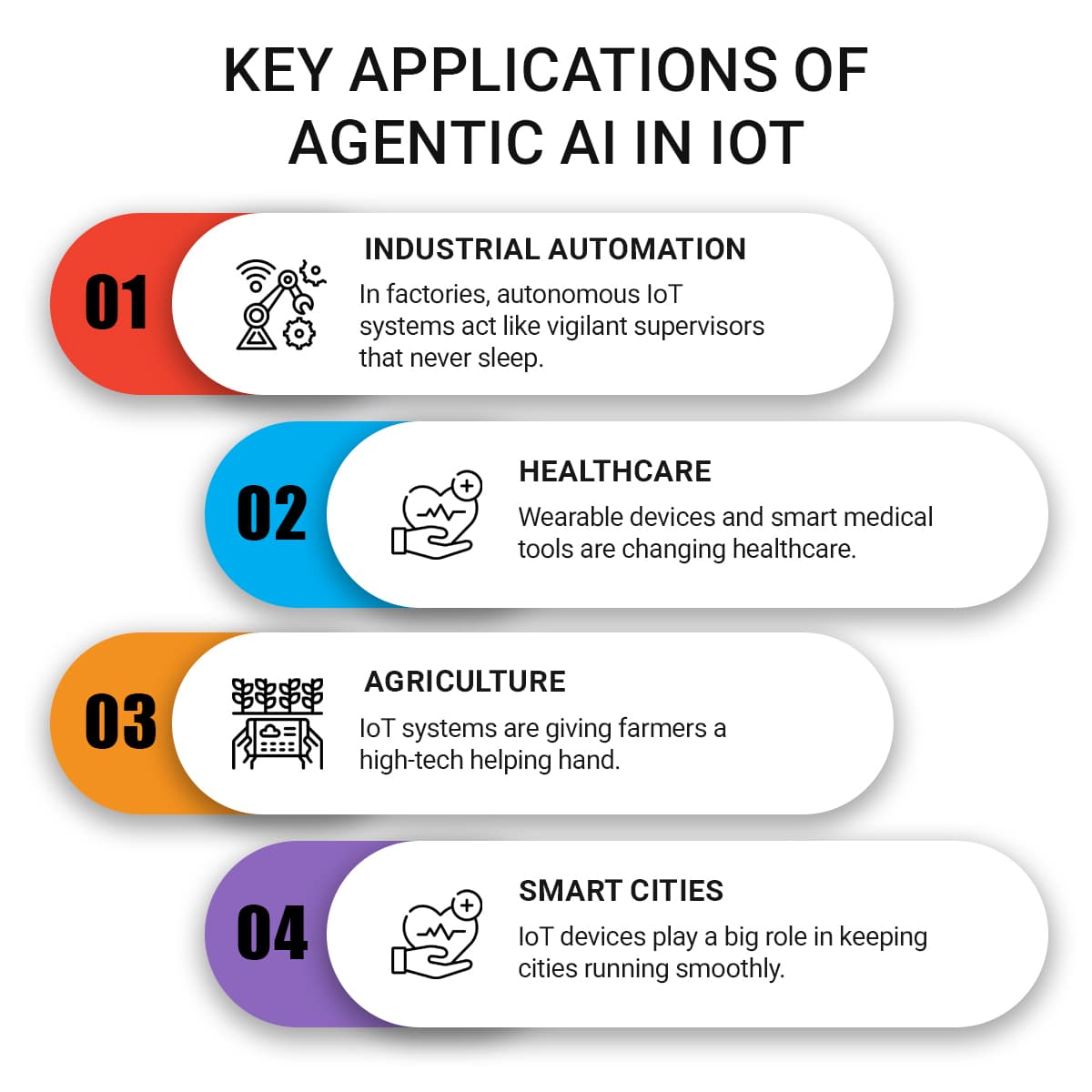
In factories, autonomous IoT systems act like vigilant supervisors that never sleep. They can predict when a machine might run into trouble, optimize production processes, and reduce costs, all without requiring constant human supervision. This helps factories run more efficiently and prevents small problems from turning into costly downtime.
Healthcare
Wearable devices and smart medical tools are changing healthcare. They monitor patients’ health in real time, send alerts to doctors or caregivers when something seems off, and can even adjust treatments automatically. This continuous monitoring helps keep patients safer and ensures they receive better, more responsive care.
Agriculture
IoT systems are giving farmers a high-tech helping hand. They monitor soil conditions, manage water usage, and track the health of crops in real time. With this data, farmers can grow healthier crops, use fewer resources, and practice more sustainable farming, making every field smarter and more productive.
Smart Cities
IoT devices play a big role in keeping cities running smoothly. They help manage traffic flow, monitor energy use, and even coordinate waste collection. By responding to real time situations, they can reduce traffic jams, save electricity, and make everyday city life more efficient.
For example, every day, city life moves at a fast pace. Roads fill with traffic, lights stay on for long hours, and waste piles up quickly. In a smart city, IoT sensors quietly track traffic and adjust signals to reduce jams. Streetlights automatically dim when no one is around, saving energy, while smart bins notify workers when they need emptying. These behind-the-scenes systems respond in real time, helping cities stay cleaner, more efficient, and easier to live in.
How Agentic AI Services Transform IoT?
Businesses today can make their IoT systems smarter and more independent with agentic AI development services. Here’s how these services help:
- Smart AI Agents:These AI systems learn and improve over time, making better decisions as they gather more information.
- Easy Connection: They can integrate with your existing IoT devices, so you don’t have to replace everything.
- Scalable Systems:As your network grows, the AI can handle more devices and more data effortlessly.
- Continuous Learning: The AI keeps learning from feedback, becoming smarter and more efficient with every action.
With these services, businesses can enjoy IoT systems that manage themselves, respond quickly, and run smoothly, without needing constant human supervision.
Choosing the Right Agentic AI Solution
Choosing the right agentic AI solution is all about finding a system that fits seamlessly with your existing IoT setup, so you don’t have to start from scratch. It should be able to process information instantly, allowing devices to respond quickly whenever conditions change.
Security is crucial, so the solution must protect data and follow industry safety standards. At the same time, it should be flexible enough to work with different types of devices and communication methods, ensuring everything connects smoothly.
When AI agents can collaborate and share information, the entire network becomes smarter. A carefully chosen solution allows IoT systems to operate independently, safely, and efficiently, making everything run more smoothly without constant human oversight.
Conclusion
The future of IoT is moving toward autonomy and intelligence. With smart AI systems, IoT networks can operate on their own, respond faster, and solve problems without constant human supervision. This makes operations smoother and more efficient across smart homes, factories, cities, healthcare, and agriculture.
Synoverge Technologies offers agentic AI solutions supported by a dedicated and experienced team, with proven experience working with global clients. Our expertise ensures IoT systems can adapt, make decisions, and perform reliably in real-world environments. As agentic AI continues to evolve, it is becoming a core part of modern connected systems, enabling faster decisions and more future-ready networks.
If you’re looking to make your IoT systems smarter and more autonomous, our team creates solutions that take care of routine tasks, making your daily life easier, more efficient, and smoothly connected, so you can focus on what truly matters. Reach out to us today and see how your IoT systems can work smarter for you.
Table of Contents


Related Blogs

Artificial Intelligence, Digital Transformation
How Agentic AI Is Transforming Business Operations in 2026
By Ritesh Dave 27 Jan, 2026
Discover how agentic AI transforms business operations through automation, real-time decisions, and smarter human-AI collaboration.


Software Development, Artificial Intelligence
Guide to SharePoint Syntex - Best Practices & Real-World Use Cases
By Vishwas Goswami May 12, 2025
Learn about SharePoint Syntex, real-world use cases, best practices for implementations, and how it will be helpful in improving productivity.

Digital Transformation
Beyond Digital Transformation
By Prashant Halari February 09, 2025
You've embraced digital transformation, overhauled your operations, and reaped the rewards in terms of improved ROI, streamlined processes, and enhanced customer experiences. But what's next? As we move beyond the era of digital transformation, it’s time to ask: