

Agentic AI has become a powerful partner in transforming the way businesses operate. It doesn’t just follow instructions; it understands the situation, makes decisions, and takes actions autonomously. It can manage entire workflows from start to finish, collaborate with other AI systems, and make real-time decisions to keep operations running smoothly.
Tasks that once took hours or days are now handled automatically, allowing teams to focus on guiding and overseeing work. From personalized customer experiences to proactive supply chain management and industry-specific solutions, agentic AI takes care of the details, ensuring efficiency and reliability. It adapts, learns, and chooses the best way to process information whether locally or in the cloud making businesses faster, smarter, and more effective.
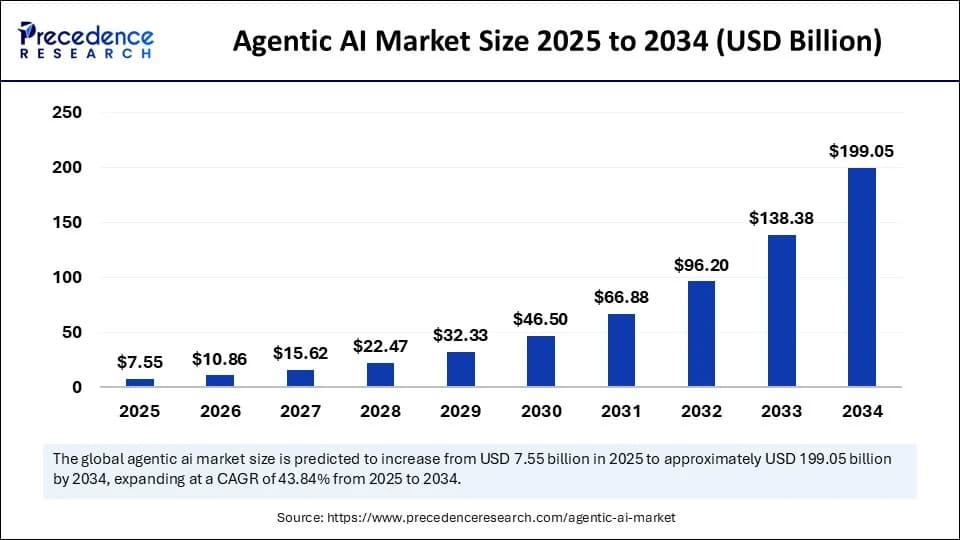
According to Precedence Research, the global agentic AI market is valued at USD 7.55 billion in 2025 and is expected to grow rapidly, reaching USD 199.05 billion by 2034. This growth reflects a strong annual growth rate of 43.84%, driven by increasing adoption across industries such as finance, transportation, defense, and healthcare.With such rapid growth, agentic AI is set to play a key role in transforming industries and driving innovation worldwide.
How Agentic AI is Changing the Way Businesses Work?
Here we will explore 10 ways Agentic AI is transforming the workplace and see how it can help your business work smarter, faster, and more efficiently.
#1. Handles Whole Processes on Its Own
Autonomous Multi-Step Workflows are transforming the way organizations get work done. Instead of simple AI tools that handle one task at a time, Agentic AI now manages entire processes from start to finish. In procurement.
For example, an AI agent can identify supplier risks, negotiate contracts, and finalize deals independently, without constant human supervision. This approach speeds up decisions, reduces errors, and frees employees to focus on strategic, high-value work, turning repetitive tasks into smooth, automated workflows that keep the business running efficiently.
#2. Coordinate teams and tasks across departments
Multi-Agent Collaboration Ecosystems are like having a team of smart AI coworkers who communicate and work together seamlessly. Instead of separate tools doing their own tasks, specialized AI agents sometimes called “swarms” coordinate across departments.
For example, a sales agent updates forecasts, which immediately signals a finance agent to adjust budgets and an operations agent to schedule production. Every step happens automatically, keeping teams aligned and processes running smoothly. With this approach, organizations can solve complex problems faster, make better decisions, and reduce the need for constant manual coordination, letting humans focus on strategy and innovation.
#3. Proactive Supply Chain Resilience
Proactive Supply Chain Resilience helps businesses stay ahead of problems and keep operations running smoothly. AI systems continuously monitor global risks such as weather changes, supplier delays, or other disruptions.
For example, if a major storm is expected to affect shipping routes, the system can reroute shipments, adjust schedules, or find alternative suppliers before delays occur. This proactive approach not only ensures that products reach customers on time but also reduces stress for teams, prevents last-minute emergencies, and allows employees to focus on planning and growth instead of constantly fixing problems.
#4. Supervise AI as it manages routine tasks efficiently
The shift from execution to oversight is changing the way humans work alongside AI. As agentic AI handles routine tasks and repetitive work, employees are no longer stuck doing manual data entry or administrative chores.
For example, in a finance team, AI can process invoices and reconcile accounts automatically, while employees focus on reviewing exceptions, setting budgets, and making strategic decisions. In this way, humans act as AI supervisors or conductors, guiding the system and focusing on high-value work, while the AI takes care of everyday operations.
#5. Act as a digital assistant for employees, 24/7
Hyper-Personalized Employee Support is like having a smart assistant working alongside every employee, 24/7. Agentic AI acts as a digital deputy, helping with tasks in real time, suggesting personalized learning paths based on performance, and taking care of everyday administrative work like scheduling or summarizing documents.
For example, in a customer support team, an AI agent can guide an employee through handling a tricky client request, suggest the best responses, and even organize follow-up tasks automatically. This kind of support boosts productivity helps employees learn faster, and reduces the stress of routine work, letting people focus on more meaningful and creative tasks.
#6. Turn large amounts of data into quick actions
Data-to-Action Decision Intelligence allows AI to turn large amounts of data into immediate, practical actions.
For example, in a finance department, an AI agent can detect unusual spending patterns, forecast upcoming cash needs, and recommend transferring funds between accounts to avoid shortages or delays. This means decisions happen automatically, errors are reduced, and employees can focus on planning, strategy, and other high-value work. By bridging the gap between data and action, Agentic AI ensures businesses stay agile and efficient.
#7. AI trained to handle tasks unique to each field
Vertical-Specific Industry Specialization means AI is trained to understand the unique needs of each industry, rather than using the same approach everywhere.
For example, in healthcare, an AI agent can monitor patient data and alert doctors about serious risks long before symptoms appear. In finance, it can track transactions and spot potential issues automatically, while in manufacturing, it can optimize production processes based on real-time data. By focusing on the specific challenges of each field, AI becomes more accurate, reliable, and valuable, helping teams make smarter decisions and achieve better outcomes.
#8. Detect stress and support employees
Real-Time Sentiment and Burnout Monitoring helps companies take care of their employees’ well-being. Agentic AI monitors communication patterns, emails, and voice tones to detect early signs of stress, fatigue, or disengagement.
For example, if an employee is showing signs of burnout, the AI can notify managers, suggest lighter workloads, recommend breaks, or provide wellness resources before the problem grows. This proactive approach keeps employees healthier and more motivated, reduces mistakes caused by stress, and helps teams stay productive while creating a supportive work environment.
#9. Boost creativity and generate ideas quickly
Creative and Generative Accelerators help humans and AI work together to get more done creatively. Agentic AI can automatically create content, design visuals, and improve marketing campaigns based on real-time results.
For example, in a marketing team, the AI can write different ad copies, test which works best, and suggest improvements, while humans focus on strategy and big ideas. This approach saves time, boosts creativity, and helps teams produce better results faster.
#10. Follows Rules and Makes Safe Decisions
Embedded Governance and Ethical Reasoning ensures that AI works safely, responsibly, and follows rules at all times. Agentic AI is designed with built-in protections, like keeping records of every action, explaining why it made decisions, and following ethical and legal limits.
For example, an AI handling finance can track all transactions, show the reasons behind each decision, and always follow company policies and laws. This gives organizations confidence that AI decisions are reliable, transparent, and accountable, even when the system operates on its own.
Agentic AI Strategy for 2026: Boost Efficiency and Productivity
Businesses are running smarter with Agentic AI as a digital partner. The focus begins with choosing the right tasks for AI that happen often and are complex so the system can make the biggest impact. Next, ensuring data is accurate and up-to-date is crucial, because AI decisions are only as reliable as the information available.
Even with AI handling much of the work independently, humans remain in control of critical decisions, reviewing outcomes and stepping in when needed. By combining smart task selection, reliable data, and human oversight, organizations can increase productivity, reduce errors, and safely get the most value from AI.
Conclusion
The work will change a lot with Agentic AI in the upcoming years. Tasks that used to take hours can now be done automatically, letting teams focus on important decisions and creative work. AI can handle data, make smart suggestions, and support employees whenever needed. At the same time, it follows rules and stays safe, so businesses can trust it.
By picking the right tasks, using accurate data, and letting humans guide important decisions, organizations can work faster, smarter, and more efficiently. With Agentic AI as a partner, the future of work is easier, more productive, and more focused on people.
At Synoverge Technologies, we are excited about the potential of agentic AI and are committed to helping businesses understand and leverage this powerful technology. By adopting autonomous AI systems, you don’t just prepare for the future; you shape it, making your workplaces smarter, more efficient, and ready for new opportunities.
Reach out to Synoverge today to see how your business can work smarter and achieve more with agentic AI.
Table of Contents


Related Blogs

Software Development, Artificial Intelligence
Guide to SharePoint Syntex - Best Practices & Real-World Use Cases
By Vishwas Goswami May 12, 2025
Learn about SharePoint Syntex, real-world use cases, best practices for implementations, and how it will be helpful in improving productivity.


Artificial Intelligence, Digital Transformation
Why Explainable AI Matters for Transparency, Trust & Better Decisions
By Ritesh Dave 10 Feb, 2026
Learn how Explainable AI improves transparency, trust, and fairness while helping businesses make confident, responsible, and compliant AI-driven decisions.

Artificial Intelligence, Digital Transformation
How Agentic AI Is Driving the Autonomous Future of IoT
By Ritesh Dave 24 Feb, 2026
Learn how agentic AI transforms IoT with real-time decision-making, predictive maintenance, enhanced security, and intelligent automation for modern industries.