

Behavior Driven Development (BDD) is a powerful agile software development methodology that bridges the gap between technical and non-technical team members. By using natural language constructs to describe desired system behaviors, BDD helps align the entire team toward a shared understanding of business requirements. This guide to Behavior Driven Development (BDD) explores its core concepts, automation process, implementation strategies, and benefits—everything a developer, QA professional, or product owner needs to know.
What is BDD in Software Testing?
Behavior Driven Development (BDD) is a collaborative approach that extends test-driven development (TDD) by encouraging teams to use readable, domain-specific language to define test cases. The scenarios are typically written in Gherkin syntax, using the Given-When-Then format. These scenarios describe the expected behavior of software from the end-user perspective, making it easier for both technical and business stakeholders to participate in the testing process.
BDD is often adopted in Agile software development environments to improve transparency, reduce rework, and accelerate feedback loops.
Example:
Let’s say you're creating a feature for an online bookstore where users can search for a book by title.
Feature: Book Search
Scenario: Search for a book by title
- Given the user is on the homepage
- When the user enters "Harry Potter" in the search bar
- Then the system should display a list of books related to "Harry Potter"
This scenario shows how BDD helps define the system’s expected behavior from the user’s point of view. It uses plain language, making it easy for developers, testers, and business stakeholders to stay aligned.
Why Use BDD? Key Benefits of the BDD Framework
Using BDD in your software development testing cycle comes with several benefits:
- Improved communication among developers, testers, and business users
- Clear documentation of system behavior and user expectations
- Early detection of requirement gaps and defects
- Living documentation that evolves with the codebase
- Higher test coverage with better focus on business value
- Supports Agile and DevOps practices
By aligning development goals with business needs, the BDD framework enables faster and more effective delivery of software solutions.
The BDD Automation Testing Process
BDD supports automation through a structured and repeatable testing cycle. Here's a breakdown of the BDD automation testing process:
1. Requirement Gathering and Analysis
Stakeholders and development teams collaborate to gather user stories and requirements. These are later converted into BDD test scenarios.
2. Feature File Creation Using Gherkin
Functional scenarios are documented in feature files using the Given-When-Then syntax, which outlines the preconditions, actions, and expected outcomes.
3. Writing BDD Test Scenarios
Detailed BDD test scenarios are written in natural language to describe user interactions and expected application behavior.
4. Automation Script Development
Automation engineers or developers write scripts in tools like Cucumber, SpecFlow, or Behave to execute BDD scenarios.
5. Step Definition Mapping
Each Gherkin step is linked to a piece of automation code that carries out the described action or validation.
6. Functional Implementation
Developers implement the actual code to fulfill the behavior defined in the test scripts.
7. Test Execution in CI/CD
BDD scenarios are integrated into the DevOps CI/CD pipeline and run automatically with each build or deployment.
8. Test Result Analysis
Test results are reviewed to identify failed scenarios, potential bugs, or deviations from expected behavior.
9. Reporting and Documentation
Results, logs, and metrics are documented for stakeholders and used for continuous improvement.
10. Feedback and Iteration
The team reviews the feedback and iterates over the product and test cases to ensure ongoing quality and alignment.
Key Features of BDD Syntax: Given-When-Then Format
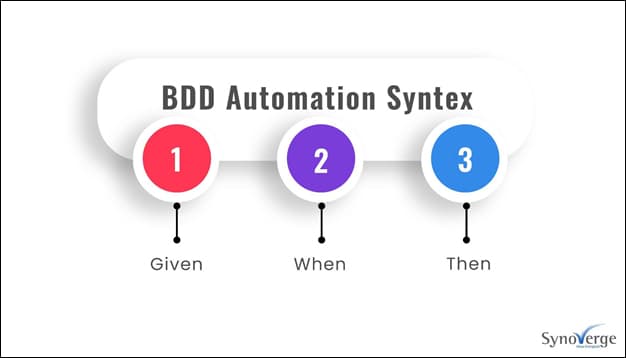
In BDD, scenarios are structured using Given-When-Then syntax:
Given: Describes the initial state or context
When: Describes the action or event
Then: Describes the expected result or outcome
For example:
- Given the user is on the login page
- When the user enters valid credentials
- Then the user should be redirected to the dashboard
This clear, consistent format ensures that everyone—from developers to business analysts—understands the intent of the test.
Best Tools for BDD Automation Testing
Several BDD testing tools support scenario writing and automation. Here are some of the most popular options:
Cucumber: - A widely-used BDD tool compatible with Java, Ruby, and JavaScript.
SpecFlow: BDD for .NET applications
TestKnot: - A user-friendly low-code automation testing tool
Behave: Python-based BDD tool
Gauge: Lightweight alternative supporting markdown syntax
JBehave: Java-based BDD tool
TestCafe: Ideal for web applications, integrates BDD-style assertions
Choosing the right tool depends on your tech stack, team experience, and automation needs.
Prerequisites for Implementing BDD Automation
Implementing automation into a software product development process requires careful planning, preparation, and consideration of various factors
- Well-defined objectives and stakeholder buy-in
- Automation strategy and roadmap
- Appropriate tools aligned with your tech stack
- Trained teams in BDD practices and tools
- Version control, CI/CD infrastructure, and test environments
- Ongoing monitoring and updates to scenarios and scripts
Conclusion
In today’s fast-paced Agile and DevOps-driven world, adopting Behavior Driven Development (BDD) can transform how teams collaborate, develop, and deliver software. By emphasizing shared understanding, test automation, and early feedback, BDD ensures software meets business expectations while reducing development time and costs.
Whether you're a QA analyst, developer, or product manager, implementing BDD in your workflow can lead to better quality, greater transparency, and a more responsive development process. Start with the right tools, foster team collaboration, and make BDD an integral part of your software lifecycle to unlock its full potential.
Ready to implement BDD in your organization? Start by choosing the right tools, training your team, and building collaboration across roles. If you need expert guidance or help integrating BDD into your development pipeline, contact us today for a personalized consultation or demo.
For more insights on software development methodologies and best practices, visit the Synoverge blog .
Table of Contents


Related Blogs

Microsoft D365
GSTR-2A Data Reconciliation
By Jainal Shah April 02, 2025
GSTR 2A is a purchase-related tax return that is automatically generated for each business by the GST portal.


Mobile App Development
Flutter and React Native Bridge Architecture Guide
By Kaushal Sukhadia 15 July, 2025
Discover how Flutter and React Native bridge native and cross-platform code, their architectures, and best practices for high-performance mobile apps.

JavaScript
Exciting Node.js Updates
By Dhwanil Shah October 01, 2024
Node.js, the versatile open-source JavaScript runtime, continues its evolution to meet industry demands. The latest buzz centers around Node.js version 20.5.1, bringing a host of enhancements to the table.Among the key features are improved diagnostics,