
Artificial Intelligence is no longer limited to helping developers write code faster. It is now transforming how modern software systems are planned, designed, developed, tested, deployed, and operated across the entire engineering lifecycle.
For years, software engineering evolved through major shifts:
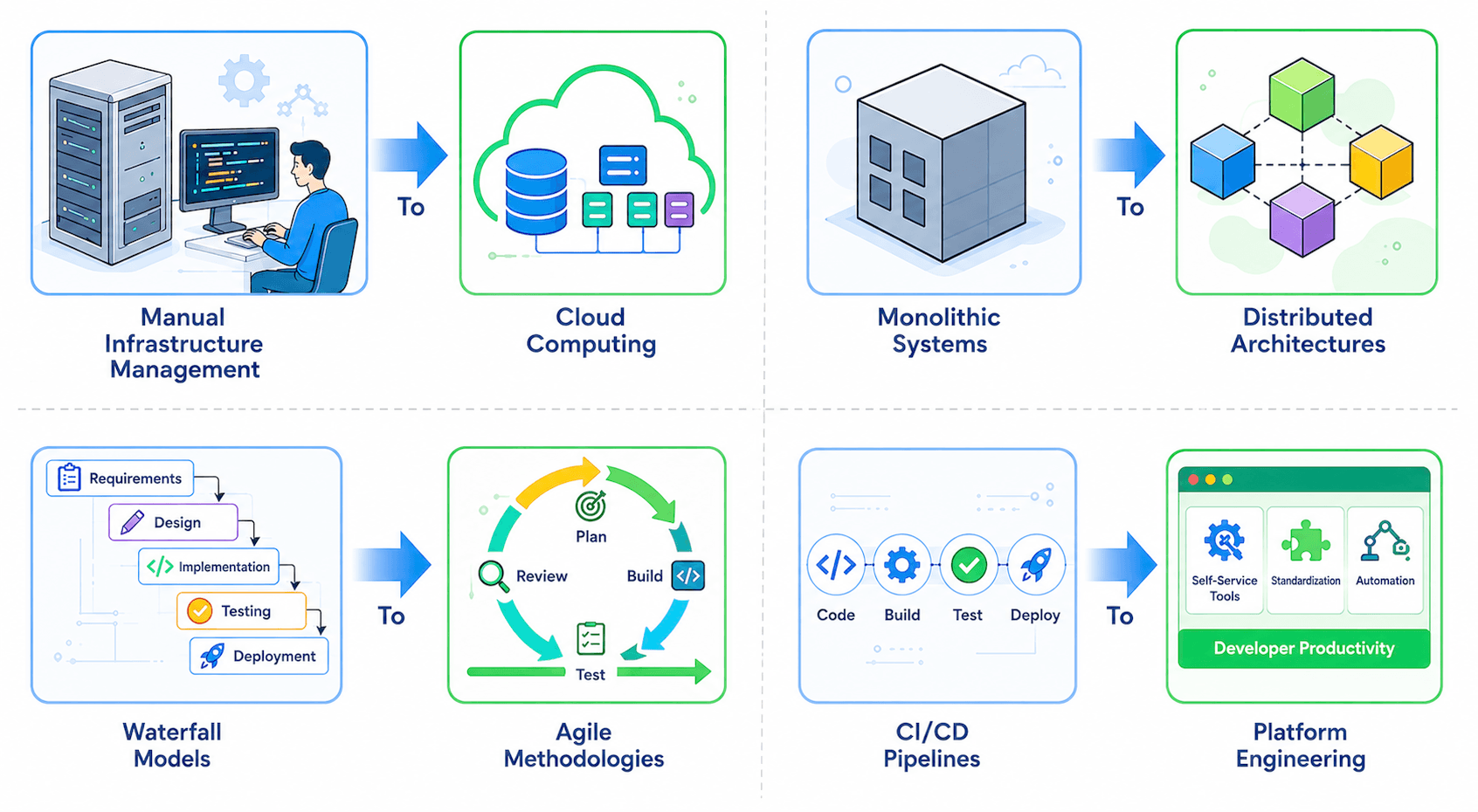
Today, another major transformation is emerging, the AI-Driven Development Lifecycle (AI-DLC).
Unlike traditional development acceleration tools, AI-DLC represents a broader evolution in software delivery where AI systems actively participate across engineering workflows, enabling organizations to build software faster, smarter, and more collaboratively.
What is AI-Driven Development Lifecycle (AI-DLC)?
AI-Driven Development Lifecycle (AI-DLC) is the evolution of the traditional Software Development Lifecycle (SDLC), where AI systems participate throughout the engineering lifecycle as collaborative assistants, planners, reviewers, and accelerators.
Unlike conventional developer tools that mainly focus on code completion, AI-DLC extends across:
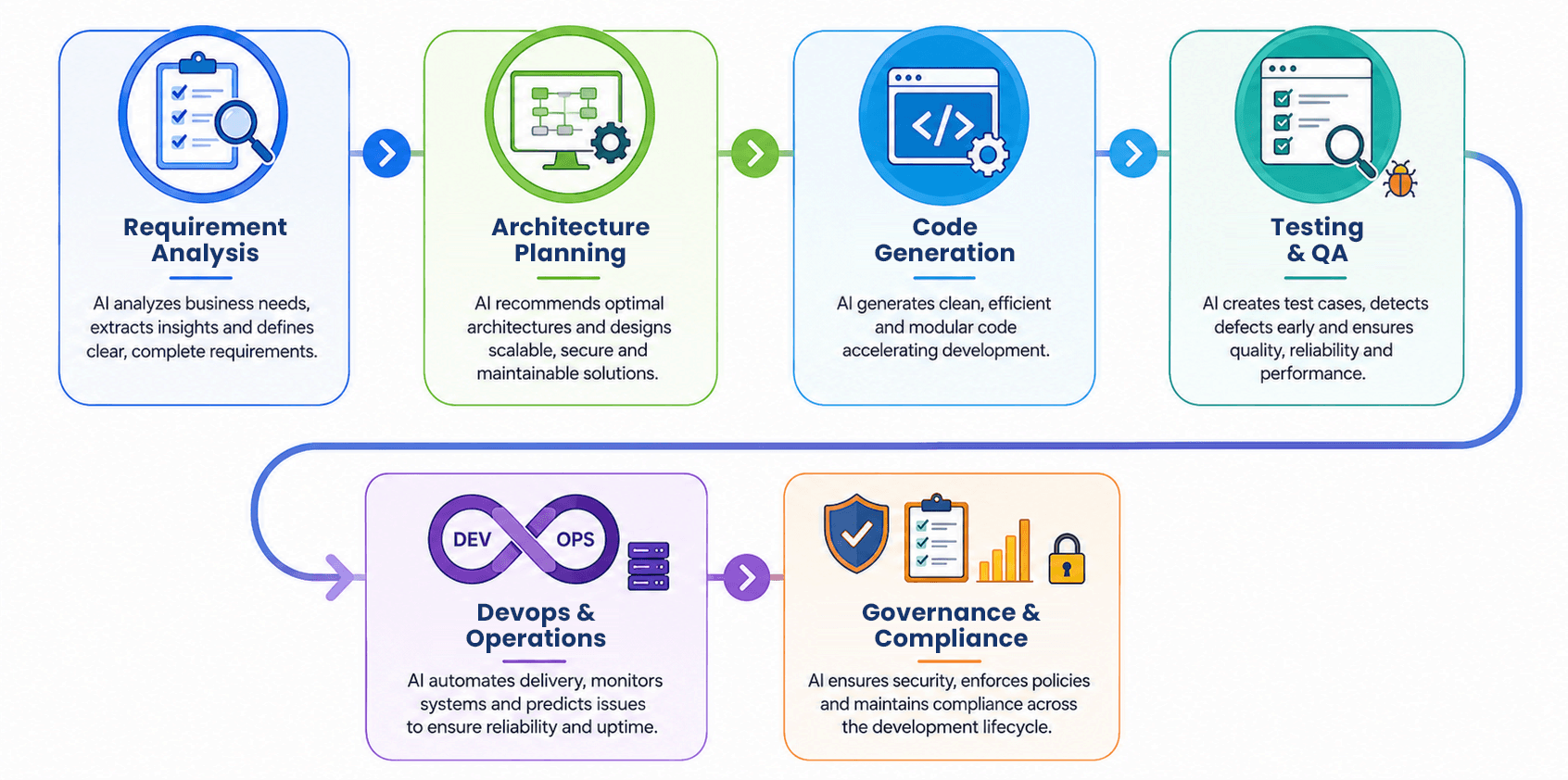
The key difference is that AI shifts from being a passive coding assistant to becoming an active participant in software delivery workflows.
Traditional SDLC primarily optimized human coordination. AI-DLC optimizes human + AI orchestration.
Traditional SDLC vs AI-DLC
AI-DLC should not be viewed as a replacement for SDLC. Instead, it is an evolution of it.
Traditional SDLC focused on coordinating teams across different phases of software development. AI-DLC introduces AI participation across these same phases to reduce friction, improve continuity, and accelerate delivery.
| Traditional SDLC | AI-DLC Evolution | Examples in Today's Tooling |
|---|---|---|
| Requirement Gathering | AI-assisted requirement synthesis | User story generation, requirement refinement |
| Architecture Design | AI-generated design exploration | Cursor Plan Mode, ADR generation, architecture reviews |
| Development | AI-assisted implementation | Copilot, Cursor Agent, Claude Code |
| Testing | Automated test generation | Unit test and integration test generation |
| Deployment | AI-assisted release orchestration | Pipeline generation, deployment validation, release planning, deployment risk analysis |
| Operations | AI-assisted operations and support | Incident summarization, log analysis, runbook generation |
| Governance | Policy-aware validation | Rule files, security checks, coding standard enforcement |
The most important shift is this:
AI is no longer isolated to coding tasks.
It is gradually becoming part of the broader software delivery system.
Understanding AI-DLC Across the Software Lifecycle
One of the best ways to understand AI-DLC is by examining how AI participates across different lifecycle stages.
1. Inception Phase
The inception phase focuses on:
A. Understanding business requirements
B. Defining architecture boundaries
C. Identifying constraints
D. Establishing project context.
AI systems are increasingly valuable here because they reduce the cost of exploration and accelerate early-stage planning.
Teams can use AI to:
a. Generate architecture drafts
b. Synthesize requirements
c. Create ADRs (Architecture Decision Records)
d. Bootstrap project documentation
e. Define engineering conventions
f. Establish reusable project context
Why Context Systems Matter
One of the biggest challenges in AI-driven software engineering is maintaining contextual continuity.
Without structured context, AI systems struggle to maintain consistency over time.
This is why organizations are adopting:
1. Project memory systems
2. Rule files
3. Repository instructions
4. Architecture guidance
5. Lifecycle context packs.
In modern AI engineering, the challenge is often not code generation; it is context formation.
2. Construction Phase
This is currently the most visible area of AI adoption.
Developers increasingly use AI-powered IDEs and coding assistants for:
A. Implementation
B. Debugging
C. Scaffolding
D. Refactoring
E. Testing
F. Documentation updates
Modern AI workflows are also evolving beyond reactive code completion toward reasoning-oriented engineering workflows.
The following features indicate a significant maturity shift in software delivery such as:
a. Planning modes
b. Multi-step execution
c. AI agents
d. Contextual engineering systems
The Real Challenge is Not Code Generation
While AI can accelerate implementation, the larger challenge is maintaining:
1. Architectural consistency
2. Governance alignment
3. Collaboration standards
4. Contextual continuity across teams.
A solo developer can often manage context mentally.
Large engineering teams cannot scale effectively on implicit context alone.
This is why structured lifecycle guidance systems are becoming increasingly important in AI-DLC adoption.
3. Operations Phase
Operations is often overlooked in AI engineering discussions, yet it may deliver some of the most practical long-term value.
AI systems are increasingly capable of:
A. Incident summarization
B. Operational analysis
C. Alert correlation
D. Remediation guidance
E. Runbook generation
F. Automated documentation maintenance.
AI-Generated Applications vs AI-Operable Systems
There is an important distinction between:
1. AI-generated applications
2. AI-operable systems
AI-operable systems remain:
i. Observable
ii. Governable
iii. Maintainable
iv. Understandable after deployment.
As organizations mature their AI-DLC practices, operational intelligence will become a critical differentiator.
Greenfield vs Brownfield: The Current Reality of AI-DLC
One of the most important discussions around AI-DLC is understanding where these systems perform effectively today and where they still struggle.
The maturity difference between greenfield and brownfield environments is significant.
Greenfield Systems
AI-DLC performs exceptionally well in greenfield environments because:
Architecture boundaries are cleaner
Conventions can be enforced early
Documentation can be AI-native from the beginning
Patterns are usually modern and consistent
In these environments:
AI-generated scaffolds work effectively
Planning systems remain coherent
Rule systems are easier to maintain
Lifecycle automation becomes more practical
Greenfield systems are currently the natural habitat of AI-DLC.
Brownfield Systems
Brownfield environments present a different set of challenges due to:
Undocumented dependencies
Legacy frameworks
Tribal knowledge
Inconsistent conventions
Partial ownership
Years of architectural drift
In these environments, AI often spends more effort reconstructing context than generating code. The challenge is not code generation itself, but understanding the system well enough to make safe and reliable changes.
As a result, AI effectiveness depends heavily on documentation maturity, architectural clarity, governance discipline, and operational visibility.
While AI-DLC maturity in brownfield systems is improving rapidly, it is still far from frictionless.
How Synoverge Helps Enterprises Build AI-Ready Software Delivery Ecosystems
Adopting AI-driven software delivery requires more than integrating AI coding tools into development workflows. Organizations need a structured engineering foundation that supports scalability, governance, operational visibility, and long-term maintainability.
At Synoverge Technologies, we help enterprises modernize their software engineering ecosystems by combining AI-driven innovation with strong architectural and operational practices.
Our expertise spans across:
AI-powered product engineering
Business intelligence and data analytics
DevOps and platform engineering
Scalable digital transformation initiatives
We help organizations build engineering environments that are:
AI-ready
Scalable
Governance-driven
Operationally resilient
And aligned with evolving business needs
From modernizing legacy systems to enabling AI-assisted development workflows, our teams focus on creating software delivery ecosystems that improve agility, collaboration, and long-term engineering efficiency.
Whether businesses are exploring:
AI-assisted software development
Workflow automation
Cloud modernization
Intelligent operational systems
Synoverge helps transform technology landscapes into future-ready digital platforms designed for continuous innovation.
As AI-native engineering systems continue to evolve, enterprises will need partners who understand both modern software architecture and practical AI adoption strategies. Synoverge brings this balanced approach to help organizations navigate the next generation of software delivery with confidence.
If your organization is looking to modernize software engineering workflows, accelerate digital transformation, or build AI-ready development ecosystems, connect with us to discuss how we can help accelerate your AI-driven engineering journey.
Conclusion
AI-Driven Development Lifecycle (AI-DLC) represents a major shift in how modern software systems are designed, developed, deployed, and managed. As AI continues evolving from coding assistance to lifecycle-wide engineering participation, organizations must rethink traditional software delivery practices to remain competitive and scalable.
While challenges around governance, legacy systems, and operational maturity still exist, the long-term potential of AI-native engineering systems is significant.
Businesses that invest in structured workflows, contextual engineering practices, and AI-ready operational foundations today will be better positioned to accelerate innovation, improve collaboration, and build future-ready digital ecosystems in the rapidly evolving software engineering landscape.
Frequently Asked Questions (FAQs)
AI-Driven Development Lifecycle (AI-DLC) is an advanced software engineering approach where AI systems assist across requirement gathering, architecture planning, development, testing, documentation, operations, and governance workflows.
Traditional SDLC mainly focuses on human-driven development processes, while AI-DLC integrates AI systems throughout the software lifecycle to improve automation, collaboration, operational intelligence, and engineering efficiency.
AI-DLC helps enterprises accelerate software delivery, improve developer productivity, maintain continuous documentation, enhance operational visibility, and build scalable engineering workflows for modern digital transformation initiatives.
AI improves software development by assisting with code generation, debugging, testing, documentation, architecture exploration, incident analysis, and workflow automation, enabling faster and more efficient engineering processes.
Organizations adopting AI-DLC may face challenges related to governance, compliance, legacy system complexity, security risks, documentation quality, context management, and maintaining consistent engineering standards.
Context systems help AI tools understand architecture decisions, project conventions, repository instructions, and engineering workflows, ensuring consistency, reliability, and continuity across AI-assisted software delivery processes.
Greenfield systems are easier for AI-DLC adoption due to modern architectures and cleaner documentation, while brownfield environments often involve legacy dependencies, undocumented workflows, and complex operational challenges.
No, AI-DLC is designed to augment developers and architects rather than replace them. Human expertise remains essential for strategic decisions, governance, architecture planning, and complex engineering problem-solving.
Industries such as finance, healthcare, manufacturing, insurance, retail, and enterprise technology can benefit from AI-DLC through improved automation, operational intelligence, workflow optimization, and accelerated software delivery.
Businesses can prepare for AI-native engineering by improving documentation practices, standardizing architectures, investing in DevOps, strengthening governance frameworks, and gradually integrating AI into software delivery workflows.
Table of Contents


Ready to Enhance Your Software Delivery Process?
Consult Synoverge experts to implement agile AI-DLC strategies.
Contact UsRelated Blogs
Software Development, Artificial Intelligence
AI Orchestration for Legacy System Modernization: A Complete Guide
By Ritesh Dave 31 Aug, 2026
Discover how AI orchestration accelerates legacy system modernization through intelligent automation, code transformation, and cloud-driven innovation.


Software Development, Artificial Intelligence
Why AI Projects Fail: 9 Reasons & How to Ensure Success
By Ritesh Dave 16 Jul, 2026
Discover why AI projects fail, the biggest implementation challenges, and proven strategies organizations use to achieve successful AI adoption and measurable ROI.

Software Development, Artificial Intelligence
Guide to SharePoint Syntex - Best Practices & Real-World Use Cases
By Vishwas Goswami May 12, 2025
Learn about SharePoint Syntex, real-world use cases, best practices for implementations, and how it will be helpful in improving productivity.