Many enterprises still rely on legacy applications that were built years or even decades ago. These systems continue to support critical business operations, but they often struggle to keep pace with modern business demands, cloud technologies, and rapidly evolving customer expectations.
Legacy systems are frequently associated with high maintenance costs, technical debt, security vulnerabilities, and limited scalability.
According to IBM, organizations spend a significant portion of their IT budgets maintaining legacy systems rather than investing in innovation initiatives.
According to Statista, global spending on digital transformation is projected to surpass $3.9 trillion by 2027, highlighting the growing urgency for enterprises to modernize their technology ecosystems and accelerate innovation.
As organizations accelerate their digital transformation initiatives, modernizing these aging applications has become a strategic necessity rather than an optional upgrade.
However, traditional modernization approaches are often time-consuming, expensive, and risky. This is where AI orchestration is transforming the modernization landscape.
By combining Artificial Intelligence, automation, and intelligent workflows, AI orchestration enables organizations to analyze, refactor, and modernize legacy systems faster and more efficiently than ever before.
This guide explores how AI orchestration is reshaping legacy system modernization and why enterprises are increasingly adopting this approach.
What Is Legacy System Modernization?
Legacy system modernization is the process of transforming older applications and technologies so they can meet today's business, security, scalability, and integration requirements.
At Synoverge, we have worked with organizations across different business environments to modernize legacy applications, re-architect existing systems, migrate data, and adopt modern technologies while preserving critical business capabilities. These initiatives can include moving from older application frameworks to modern Microsoft .NET architectures, improving user experiences, strengthening system performance, and introducing automated testing.
For example, one of our modernization engagements involved transforming a complex legacy law enforcement software product into a modern .NET-based architecture.
Explore the law enforcement software modernization case study to learn more about this transformation and the approach we followed.
Why Traditional Modernization Approaches Often Fail
Although modernization is necessary, many initiatives fail due to several challenges.
Research from McKinsey indicates that nearly 70% of digital transformation initiatives fail to achieve their intended outcomes, often due to technology complexity, organizational challenges, and execution gaps.
01. Lack of Documentation
Many legacy systems have evolved over years without proper documentation, making it difficult to understand application dependencies and workflows.
02. High Costs
Traditional modernization projects often require significant investments in skilled resources, infrastructure, and consulting services.
03. Long Timelines
Manual assessment and migration processes can take months or even years.
04. Hidden Dependencies
Legacy applications frequently have complex integrations and undocumented dependencies that create unexpected risks.
05. Skill Gaps
Organizations struggle to find professionals with expertise in both legacy technologies and modern architectures.
06. Business Disruptions
Modernization projects can negatively impact business operations if not executed carefully.
These challenges have created a strong demand for intelligent, automated modernization approaches.
While modernizing legacy systems with AI offers significant advantages, success depends on more than just adopting the technology.
Organizations also need clear business objectives, strong data foundations, effective governance, and user adoption to achieve measurable outcomes. Learn more about the common reasons why AI projects fail and the best practices to ensure successful AI implementation in our detailed guide.
What Is AI Orchestration?
AI orchestration refers to the coordinated use of multiple AI systems, tools, agents, and automation workflows to accomplish complex tasks.
In legacy modernization, AI orchestration brings together various capabilities, including:
Application discovery
Code analysis
Dependency mapping
Documentation generation
Refactoring recommendations
Testing automation
Migration planning
Deployment automation
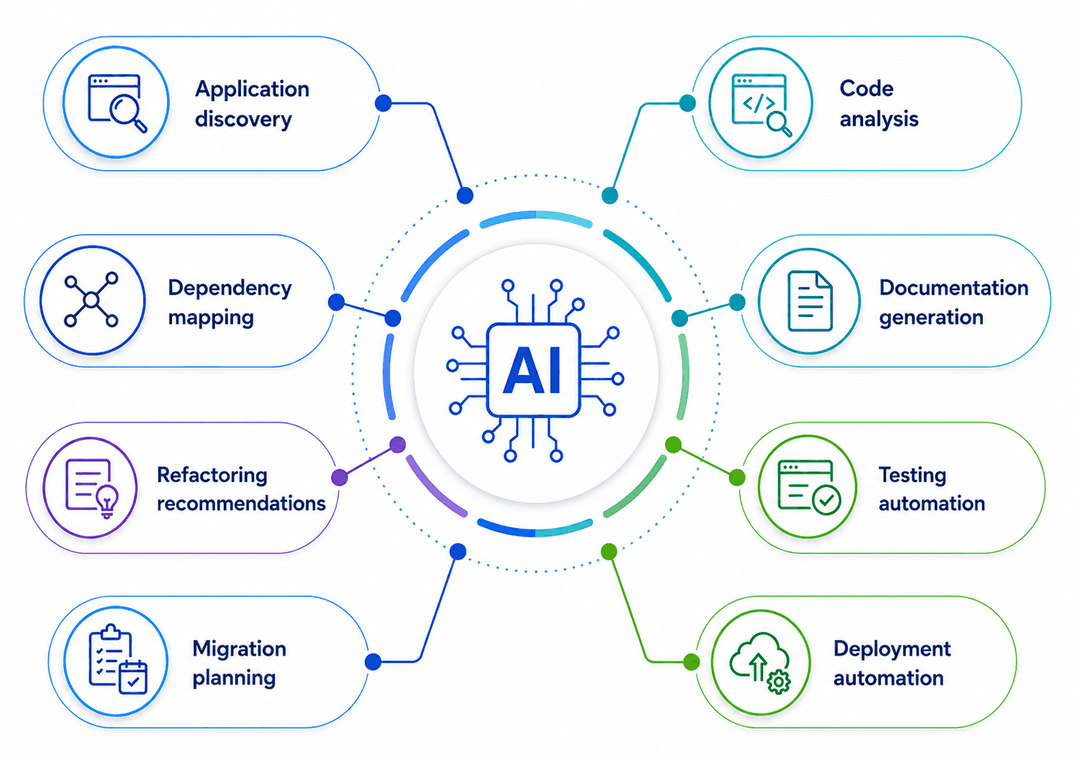
Rather than relying on isolated automation tools, AI orchestration creates an interconnected workflow where each AI component contributes to the modernization process.
In simple terms:
How Is AI Orchestration Transforming Legacy System Modernization?
For many organizations, legacy modernization is not a single migration task. It involves understanding years of application changes, identifying hidden dependencies, transforming code, validating business logic, and ensuring that the modernized system continues to work as expected. AI orchestration changes this process by connecting these activities into a coordinated workflow rather than treating them as separate tasks.
Consider an organization running a decades-old claims processing application. Instead of relying on teams to manually review thousands of lines of code and map dependencies, AI can analyze the application, identify relationships between databases and services, and generate documentation. The same orchestrated workflow can then assist with code transformation, recommend migration priorities, automate testing, and support deployment.
This approach allows modernization teams to move from fragmented, manual activities toward a more connected and intelligent process. AI does not simply perform individual tasks; orchestration enables different AI capabilities to work together while keeping human experts involved in important decisions. As a result, organizations can gain better visibility into their legacy environments, identify risks earlier, reduce repetitive effort, and accelerate their transition toward modern, scalable architectures.
How AI Orchestration Works in Legacy Modernization
AI orchestration brings structure to the modernization journey by connecting different AI capabilities and automation activities into a coordinated process. Instead of treating application discovery, code transformation, testing, and deployment as isolated activities, orchestration allows each stage to build on the information generated in the previous stage.
Step 1: Discover the Existing Application
The journey begins with application assessment. AI analyzes the existing codebase, technologies, infrastructure, and configurations to build a clearer picture of the legacy environment.
Step 2: Understand Dependencies and Architecture
Once the application is assessed, AI maps relationships between applications, databases, APIs, and third-party systems. This helps teams uncover dependencies that may not be clearly documented.
Step 3: Plan the Modernization Approach
Using the information gathered, AI can help identify modernization priorities, recommend suitable strategies, and support migration planning based on application complexity and business requirements.
Step 4: Transform and Refactor the Code
Generative AI can assist developers with code conversion, refactoring, documentation, and API generation. Human experts can then review and validate the changes before they move forward.
Step 5: Test, Deploy, and Monitor
The process continues with automated regression, functional, performance, and security testing. Once validated, the modernized application can move through deployment and continuous monitoring, allowing teams to identify issues and optimize the system over time.
AI orchestration brings the pieces of legacy modernization together, from discovery and planning to transformation, testing, and deployment. This helps organizations reduce complexity, make informed decisions, and move toward modern architectures with greater confidence.
Traditional vs AI-Orchestrated Approaches to Legacy Modernization
Traditional legacy modernization often involves manual assessments, multiple disconnected tools, and significant reliance on specialized technical expertise. AI orchestration introduces a more integrated approach by coordinating AI capabilities across application discovery, dependency analysis, code transformation, testing, migration planning, and deployment.
This enables organizations to reduce manual effort, improve visibility, identify risks earlier, and accelerate modernization while maintaining greater control over the transformation process.
| Traditional Modernization | AI-Orchestrated Modernization | Related Example |
|---|---|---|
| Manual assessments | Automated discovery | AI analyzes a large legacy codebase and identifies applications, technologies, and dependencies. |
| Months of analysis | Analysis completed in days | AI scans repositories and system configurations to accelerate application assessment. |
| High dependency on experts | AI-assisted decision-making | AI identifies modernization opportunities and recommends suitable migration approaches. |
| Manual documentation | Automated documentation | AI generates application documentation, architecture summaries, and code explanations from existing systems. |
| Reactive risk management | Predictive risk analysis | AI identifies hidden dependencies and potential migration risks before implementation begins. |
| Limited automation | End-to-end intelligent workflows | AI coordinates discovery, code transformation, testing, and deployment activities across the modernization lifecycle. |
| Manual code refactoring | AI-assisted code transformation | Generative AI helps convert or refactor legacy code for modern programming frameworks. |
| Manual dependency mapping | Intelligent dependency analysis | AI maps relationships between legacy applications, databases, APIs, and third-party systems. |
| Manual testing and validation | AI-powered testing automation | AI supports regression, functional, performance, and security testing during modernization. |
| Siloed modernization activities | Connected AI-driven orchestration | Multiple AI capabilities work together to coordinate assessment, migration planning, transformation, testing, and monitoring. |
Traditional Modernization
AI-Orchestrated Modernization
Related Example
Technologies Powering AI-Orchestrated Modernization
AI orchestration combines several AI and engineering technologies to understand legacy environments, automate modernization tasks, and coordinate transformation workflows.
Generative AI
Generative AI assists with code generation, refactoring, documentation, and code conversion. For example, it can help transform older application code into a modern framework while allowing developers to review and validate the generated output.
Machine Learning
Machine learning helps identify patterns, dependencies, anomalies, and potential modernization risks across large application environments. For example, ML models can analyze historical application data to identify components that may require additional attention during migration. For a practical example of how AI and machine learning can identify anomalies and potential risks, explore our article on AI-powered anomaly detection in logistics .
Knowledge Graphs
Knowledge graphs connect applications, databases, services, APIs, and other system components to create a relationship-based view of the legacy environment. For example, they can help teams understand which applications may be affected when a particular database or service is changed.
Retrieval-Augmented Generation (RAG)
RAG combines AI generation with relevant information retrieved from enterprise sources, helping AI provide more contextual responses. For example, a RAG-based system can use existing code, documentation, architecture information, and business rules when assisting with modernization decisions.
Agentic AI
Agentic AI enables specialized AI agents to perform tasks, make decisions within defined boundaries, and collaborate as part of a larger workflow. In legacy modernization, for example, one agent can analyze legacy code while another identifies dependencies and a third supports testing activities. To understand how agentic AI can coordinate workflows and support autonomous business processes, explore our article on how agentic AI is transforming business operations .
DevOps Automation
DevOps automation connects development, testing, deployment, and monitoring activities into repeatable workflows. During modernization, automated CI/CD pipelines can help teams validate code changes, run tests, deploy updated applications, and monitor their performance continuously.
Together, these technologies provide the foundation for AI orchestration, enabling organizations to move beyond individual AI tools and create coordinated modernization workflows that connect discovery, transformation, validation, and deployment.
How Synoverge Helps Enterprises Modernize Legacy Systems with AI Orchestration
Modernizing legacy systems requires more than just migrating applications to newer technologies; it demands a strategic approach that minimizes risk, accelerates transformation, and ensures long-term business value.
At Synoverge, we combine our expertise in AI, cloud, and enterprise software product engineering to help organizations modernize complex legacy environments with confidence.
Our team helps enterprises assess their existing applications, identify modernization opportunities, and develop AI-driven roadmaps tailored to their business goals. By leveraging AI orchestration, automation, and modern engineering practices, we enable organizations to accelerate application transformation while reducing costs and operational disruptions.
Our core capabilities include:
Legacy Application Assessment and Modernization Strategy
Cloud Migration and Azure Modernization Services
Microsoft Dynamics 365 Services, Implementation and Modernization
Application Re-architecting and Microservices Transformation
DevOps and CI/CD Enablement
API and Integration Modernization
Quality Engineering and Automated Testing
As a technology partner with deep expertise in Microsoft technologies, Azure cloud services, Dynamics 365, DevOps, and enterprise application engineering, Synoverge helps businesses modernize legacy systems and build scalable, future-ready digital ecosystems.
Whether you're looking to modernize an aging ERP platform, migrate applications to the cloud, implement Microsoft Dynamics 365, or adopt AI-powered engineering practices, our team can help you navigate every stage of your transformation journey.
Ready to Modernize Your Legacy Systems?
Unlock the full potential of your applications with AI-powered modernization strategies tailored to your business needs.
Get in touch with our experts to discuss your modernization goals and build a roadmap for your digital transformation journey.
Conclusion
Legacy systems remain critical to many organizations, but they often become barriers to innovation and growth. Traditional modernization approaches can be costly, time-consuming, and risky.
AI orchestration is changing this reality by enabling intelligent, automated, and data-driven modernization strategies. By combining AI capabilities with human expertise, organizations can modernize legacy applications faster, reduce operational risks, and accelerate their digital transformation initiatives.
As enterprises continue their journey toward cloud-native and AI-driven architectures, AI orchestration is poised to become a foundational capability for successful legacy system modernization.
Frequently Asked Questions (FAQs)
AI orchestration in legacy modernization refers to the coordinated use of multiple AI technologies, automation tools, and intelligent workflows to analyze, transform, and modernize legacy applications. It combines capabilities such as code analysis, dependency mapping, documentation generation, testing, and migration planning into a unified process. By orchestrating these activities, organizations can reduce manual effort, accelerate modernization initiatives, and minimize the risks associated with complex application transformations.
AI helps modernize legacy applications by automating time-consuming tasks that traditionally require significant manual effort. It can analyze large codebases, identify dependencies, generate technical documentation, recommend modernization strategies, assist with code refactoring, and automate testing processes. AI also provides predictive insights that help organizations make informed decisions, reduce project risks, and accelerate the transition to modern architectures such as cloud-native and microservices-based applications.
AI can significantly accelerate legacy code conversion by generating code recommendations, refactoring outdated components, and assisting in migrating applications to modern programming languages and frameworks. However, complete automation is rarely possible for complex enterprise systems. Human expertise is still required to validate business logic, review AI-generated outputs, address compliance requirements, and ensure that the modernized application aligns with organizational goals and operational requirements.
AI-driven modernization offers several advantages, including faster application assessments, reduced costs, improved code quality, and lower migration risks. It also enhances developer productivity by automating repetitive tasks and generating actionable insights. By accelerating modernization timelines and improving decision-making, AI enables organizations to adopt modern technologies more efficiently and respond quickly to changing business requirements and customer expectations.
Yes, AI orchestration is particularly valuable for large enterprises because they often operate highly complex application landscapes with numerous dependencies and legacy technologies. AI-powered tools can analyze vast amounts of code and system data much faster than traditional methods. This enables enterprises to prioritize modernization initiatives, reduce operational risks, and execute large-scale transformation projects with greater confidence and efficiency.
Industries such as banking, insurance, healthcare, manufacturing, retail, and logistics can significantly benefit from AI-driven modernization. These sectors often rely on legacy applications that support mission-critical processes and manage large volumes of data. AI orchestration helps these organizations modernize their technology ecosystems, improve operational efficiency, strengthen security, and accelerate digital transformation initiatives while maintaining business continuity.
Some of the biggest challenges include undocumented dependencies, outdated technologies, technical debt, skill shortages, and the risk of business disruptions during migration. Many organizations also struggle with estimating costs and choosing the right modernization approach. AI orchestration helps address these challenges by providing intelligent analysis, automating assessments, and generating data-driven recommendations that reduce uncertainty and improve project outcomes.
The timeline for legacy modernization depends on factors such as application complexity, the number of systems involved, business requirements, and the chosen modernization strategy. Traditional modernization projects can take several months or even years to complete. However, AI-powered assessments and automation capabilities can significantly reduce project timelines by accelerating application discovery, code analysis, testing, and migration planning activities.
AI orchestration reduces modernization risks by identifying application dependencies, uncovering hidden issues, and generating predictive insights before migration begins. It can also automate testing and continuously validate modernization efforts to ensure system stability and performance. By providing better visibility into application environments and supporting informed decision-making, AI enables organizations to minimize disruptions and improve the success rate of modernization initiatives.
Organizations should begin by conducting a comprehensive assessment of their existing application landscape to understand dependencies, technical debt, and business priorities. The next step is to define modernization objectives and develop a phased roadmap aligned with business goals. Partnering with experienced technology providers and adopting AI orchestration tools can help organizations accelerate their modernization journey while reducing costs, risks, and implementation challenges.
Table of Contents
- Ai Orchestration Overview
- What Is Legacy System Modernization?
- Why Traditional Modernization Approaches Often Fail
- What Is AI Orchestration?
- How Is AI Orchestration Transforming Legacy System Modernization?
- How AI Orchestration Works in Legacy Modernization
- Traditional vs AI-Orchestrated Approaches to Legacy Modernization
- Technologies Powering AI-Orchestrated Modernization
- How Synoverge Helps Enterprises Modernize Legacy Systems with AI Orchestration
- Conclusion
- Frequently Asked Questions (FAQs)


Want to Make Your AI Projects Successful?
Talk to our AI experts and achieve measurable ROI.
Contact UsRelated Blogs
Software Development
How to Select a Software Partner That Delivers
By Ritesh Dave February 14, 2025
For ISVs, Independent Software Consultants, and SMEs, selecting the right software development partner is critical for growth, innovation, and gaining a competitive edge. Partnering with the ideal development team can even yield cost savings of 60-70% on web development projects.


Software Development, Artificial Intelligence
Guide to SharePoint Syntex - Best Practices & Real-World Use Cases
By Vishwas Goswami May 12, 2025
Learn about SharePoint Syntex, real-world use cases, best practices for implementations, and how it will be helpful in improving productivity.
Artificial Intelligence, Digital Transformation
How Agentic AI Is Driving the Autonomous Future of IoT
By Ritesh Dave 24 Feb, 2026
Learn how agentic AI transforms IoT with real-time decision-making, predictive maintenance, enhanced security, and intelligent automation for modern industries.