

Most organizations are investing in AI. Very few are getting meaningful returns.
According to McKinsey’s State of AI 2025 report, 88% of companies use AI in at least one business function, yet only about one-third have successfully scaled it across the enterprise. Just 39% report any measurable impact on EBIT. Gartner predicts that more than 40% of agentic AI projects will be canceled by the end of 2027 due to unclear business value, rising costs, and hype-driven implementations.
The technology is rarely the real problem. Most AI projects fail because of gaps in strategy, data, governance, and adoption.
In this blog, we examine the nine most common reasons AI initiatives fail, and what successful organizations do differently to turn AI into real business outcomes.
What Does AI Project Failure Actually Mean?
An AI project does not have to be cancelled to be considered a failure. Many initiatives reach deployment but still fail because they do not deliver measurable business value.
Success is not defined by model accuracy alone. It is defined by whether the solution improves operational efficiency, enhances customer experience, increases productivity, or generates positive ROI.
A technically strong solution that remains unused or fails to influence business decisions is still a failure.
Common Reasons Why AI Projects Fail
Most AI projects don't fail because of the technology, they fail because of gaps in strategy, data, governance, and adoption. While every organization faces unique challenges, the following are the most common reasons AI initiatives struggle to deliver measurable business value.
01. Starting with Technology Instead of the Business Problem
Many organizations adopt AI because it is trendy rather than because it solves a clearly defined business challenge. This often results in impressive technology that delivers little real impact.
02. Poor Data Quality and Readiness
AI models are only as reliable as the data behind them. Incomplete, inconsistent, or siloed data leads to inaccurate outputs and erodes trust in the solution.
03. Unrealistic Expectations
Expecting immediate ROI or full automation of complex processes is a common mistake. When results take longer than expected, leadership support quickly declines.
04. Lack of Executive Sponsorship
Without strong leadership support, AI projects struggle with unclear priorities, limited resources, and weak cross-functional alignment.
05. Weak AI Strategy and Governance
Launching AI without clear ownership, success metrics, compliance guidelines, and risk management creates confusion and long-term risk.
06. Low Employee Adoption
Even the best AI solution fails if employees do not use it. Resistance usually stems from limited training, poor communication, or fear of change.
07. Scaling Too Quickly
Attempting enterprise-wide AI transformation before validating smaller use cases increases complexity, cost, and failure risk.
08. Poor Integration with Existing Systems
AI delivers limited value when it sits outside core business systems such as ERP, CRM, or operational platforms. Seamless integration is essential for real adoption.
09. Failing to Monitor and Improve AI Over Time
AI is not a one-time deployment. Without continuous monitoring, retraining, and optimization, performance degrades and business value declines.
What Successful Organizations Do Differently
While every AI initiative is unique, successful organizations consistently avoid the common pitfalls that cause many projects to underperform. The table below summarizes the key differences between failing AI initiatives and those that deliver measurable business value.
Common Reasons AI Projects Fail
What Successful Organizations Do Differently
These differences highlight an important reality: successful AI initiatives aren't defined by the sophistication of the technology, but they're driven by strategic planning, strong leadership, quality data, effective governance, and a relentless focus on delivering measurable business outcomes.
A Step-by-Step Framework for Successful AI Implementation
While every organization has unique business goals, the journey to AI success follows a similar path. Organizations that achieve measurable ROI rarely rush into development. Instead, they follow a structured approach that minimizes risk, validates assumptions, and creates a clear roadmap for scaling AI across the business.
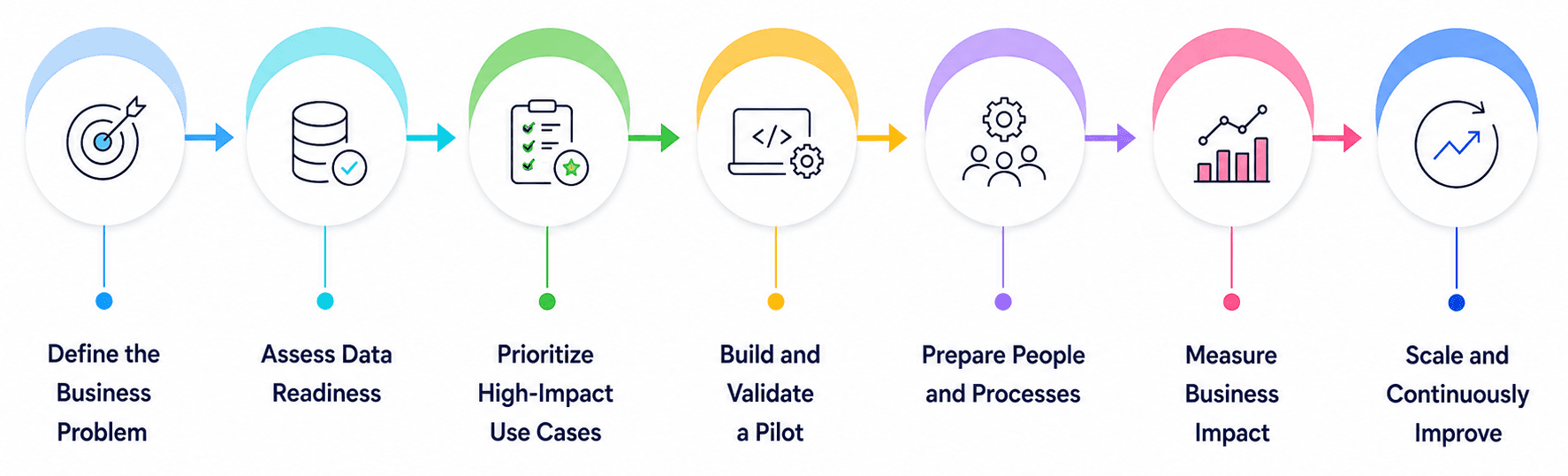
01. Define the Business Problem
Start with a clear business challenge rather than asking where AI can be applied.
02. Assess Data Readiness
Evaluate data quality, accessibility, consistency, and governance before development begins.
03. Prioritize High-Impact Use Cases
Focus on opportunities that are both feasible and capable of delivering measurable value.
04. Build and Validate a Pilot
Develop a controlled pilot to test assumptions, gather feedback, and measure outcomes.
05. Prepare People and Processes
Invest in training, communication, and change management to drive adoption.
06. Measure Business Impact
Track productivity, cost savings, customer satisfaction, and ROI, not just technical metrics.
07. Scale and Continuously Improve
Expand successful pilots gradually while continuously monitoring and optimizing performance.
Following this framework helps organizations move beyond isolated AI experiments and build solutions that deliver consistent, measurable business outcomes. Rather than chasing the latest AI trends, successful organizations focus on solving real business problems, validating results, and scaling with confidence.
How Synoverge Helps Organizations Succeed with AI
At Synoverge, we help organizations move beyond experimental AI projects and build AI solutions that deliver measurable business outcomes. Our approach focuses on:
Identifying high-value use cases aligned with business goals
Strengthening data foundations and governance
Integrating AI seamlessly with existing enterprise systems
Supporting adoption through practical change management
Building scalable, cloud-native AI architectures
Whether you are exploring your first AI initiative or looking to scale existing capabilities, we help ensure AI investments create lasting business value. Reach out to us for more information.
| Common AI Implementation Challenge | How Synoverge Helps |
|---|---|
| Unclear business objectives | We conduct AI discovery workshops and business assessments to identify high-value use cases aligned with your strategic goals before recommending any AI solution. |
| Poor data quality and fragmented systems | Our team evaluates data readiness, improves data quality, establishes governance, and integrates data across enterprise systems to create a reliable foundation for AI. |
| Choosing the wrong AI use case | We prioritize AI opportunities based on business impact, technical feasibility, implementation complexity, and expected ROI. |
| Legacy system integration challenges | We integrate AI capabilities with existing ERP, CRM, document management, and enterprise applications to ensure seamless adoption without disrupting existing workflows. |
| Weak AI governance and security | We help organizations establish governance frameworks, define KPIs, implement responsible AI practices, and ensure compliance with enterprise security requirements. |
| Low employee adoption | We support change management through stakeholder engagement, user training, and workflow optimization to encourage organization-wide AI adoption. |
| Difficulty scaling AI initiatives | Our scalable cloud-native architectures, continuous monitoring, and optimization strategies help organizations confidently expand successful AI initiatives across the enterprise. |
Conclusion
AI projects rarely fail because of technology. They fail when strategy, data, governance, and people are overlooked.
Organizations that succeed start with clear business problems, build strong foundations, validate through pilots, and scale with discipline. With the right approach and the right partner, AI can move from an experimental initiative to a reliable driver of long-term growth.
Frequently Asked Questions (FAQs)
AI projects rarely fail because of the technology itself. Most failures stem from business-related challenges such as unclear objectives, poor-quality data, lack of executive sponsorship, unrealistic expectations, weak governance, and low employee adoption. Organizations that align AI initiatives with measurable business goals and establish a strong implementation strategy are significantly more likely to achieve successful outcomes.
The biggest challenge is connecting AI technology with real business value. Many organizations focus on selecting AI tools before identifying the problem they want to solve. Successful AI implementation requires a combination of high-quality data, leadership support, skilled teams, well-defined processes, and effective change management to ensure the solution delivers measurable business impact.
Organizations can improve AI project success by starting with clearly defined business objectives, assessing data readiness, selecting practical use cases, involving stakeholders from both business and technical teams, and implementing strong AI governance. Beginning with pilot projects, measuring business outcomes, and continuously refining AI models also increases the likelihood of long-term success.
A successful AI project delivers measurable business value rather than simply demonstrating technical capabilities. Success is typically measured through improved operational efficiency, cost savings, better customer experiences, increased productivity, higher employee adoption, and positive return on investment. Organizations that continuously monitor and optimize AI performance achieve more sustainable results over time.
AI success should be measured using business-focused key performance indicators (KPIs) rather than model accuracy alone. Common metrics include process automation rates, productivity improvements, operational cost reductions, customer satisfaction scores, revenue growth, decision-making speed, and ROI. Measuring these outcomes helps organizations determine whether AI is delivering meaningful business value.
Yes. AI is no longer limited to large enterprises with extensive budgets. Many cloud-based AI platforms and industry-specific solutions make AI accessible for small and medium-sized businesses. By starting with focused, high-impact use cases such as customer support automation, document processing, demand forecasting, or workflow optimization, SMBs can achieve significant business benefits while minimizing implementation risks.
Data serves as the foundation of every AI system. If the data is incomplete, inconsistent, outdated, or biased, AI models will generate inaccurate or unreliable results regardless of how advanced the underlying technology is. Investing in data governance, cleansing, integration, and continuous monitoring ensures AI solutions remain accurate, trustworthy, and capable of delivering consistent business value.
Table of Contents
- Artificial intelligence is rapidly transforming
- What Does AI Project Failure Actually Mean?
- Common Reasons Why AI Projects Fail
- Why AI Projects Fail vs. What Successful Organizations Do Differently
- A Step-by-Step Framework for Successful AI Implementation
- How Synoverge Helps Organizations Overcome Common AI Implementation Challenges
- Conclusion
- Frequently Asked Questions (FAQs)


Want to Make Your AI Projects Successful?
Talk to our AI experts and achieve measurable ROI.
Contact UsRelated Blogs

Software Development
Project Methodology
By Namrata Gupta April 21, 2025
Agile methodologies have been around for over two decades and have not only changed the way we deliver software but also evolved multi-fold over these two decades.


Software Development, Artificial Intelligence
AI Orchestration for Legacy System Modernization: A Complete Guide
By Ritesh Dave 31 Aug, 2026
Discover how AI orchestration accelerates legacy system modernization through intelligent automation, code transformation, and cloud-driven innovation.

Artificial Intelligence
How AI Detects Anomalies and Prevents Risks in Logistics?
By Sagar Vaidya 06 Jan, 2026
Discover how AI in logistics enhances visibility, detects anomalies, and prevents risks using real-time analytics, predictive insights, and automated decision-making.