

Your API rarely operates alone.
A single request may depend on payment services, identity providers, databases, inventory systems, message brokers, or other internal and external APIs.
When these dependencies are healthy, everything feels seamless. But when one becomes slow or unavailable, the impact can spread quickly.
A payment service starts taking several seconds to respond. The API waits. More requests arrive. Connections pile up. Threads and workers become occupied. Eventually, the API itself slows down, clients start timing out, and their retries generate even more traffic.
A small problem in one service can quickly become a system-wide incident. This is the cascading failure problem.
Building an API that simply "works" isn't enough. A production API also needs to know how to behave when dependencies are slow, unavailable, overloaded, or temporarily failing.
That's where API resilience comes in: designing a system that detects failures quickly, contains their impact, recovers from temporary problems, protects critical resources, and keeps providing useful functionality wherever possible.
In this article, we'll explore four core API resilience patterns for handling dependency failures:
- Timeouts
- Retries
- Exponential backoff and jitter
- Circuit breakers
The goal is simple:
One dependency failure should not become a system-wide failure.
The Cascading Failure Problem
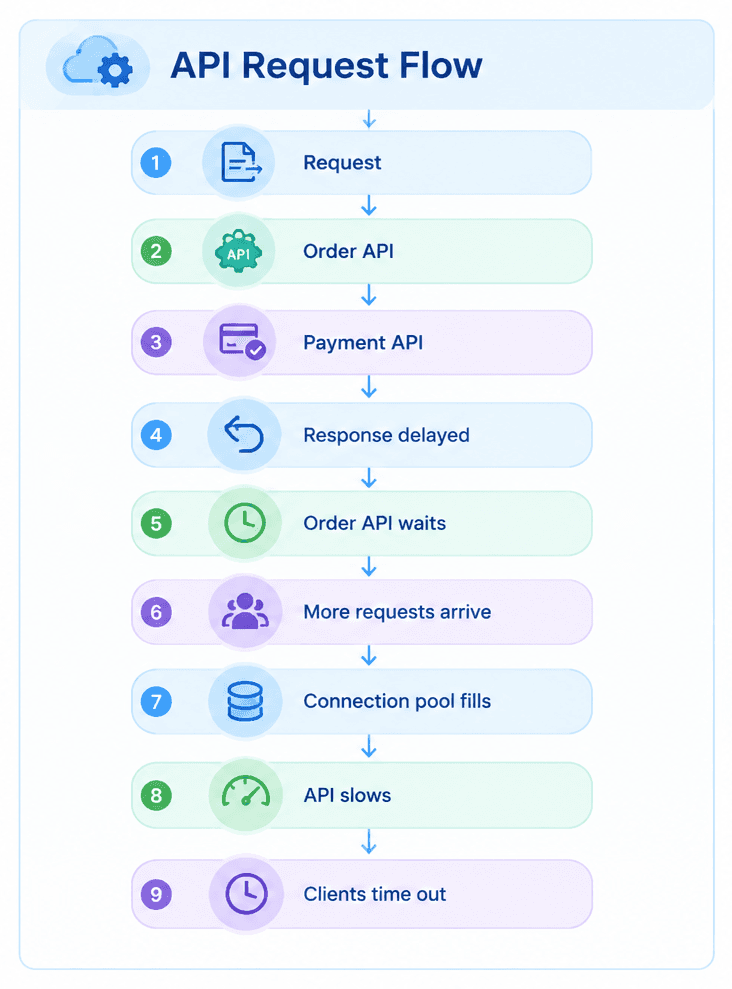
The original problem is the Payment API, but the impact doesn't stay there.
The Order API starts waiting for responses, its connection pool fills up, new requests have fewer resources available, latency increases, and clients begin timing out.
The failure has spread.
This is a cascading failure, and API resilience is about containing that blast radius before one dependency problem affects the entire system.
1. Start With Explicit API Timeouts
One of the simplest and most important, API resilience techniques is also one of the easiest to overlook:
Never allow an external operation to wait indefinitely.
Every call to a remote dependency should have a defined timeout.
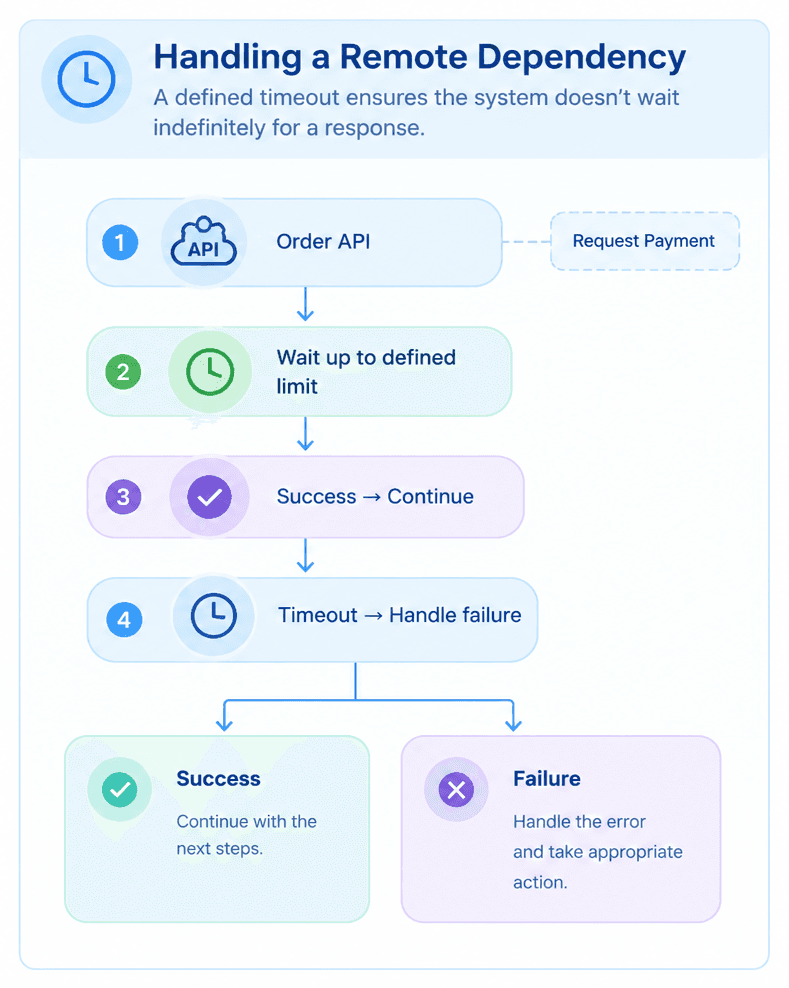
Without a timeout, a slow dependency can tie up application resources for an unpredictable amount of time.
Depending on the system, timeouts may need to exist at several levels:
- Connection timeout
- DNS/network timeout
- Request timeout
- Response/read timeout
- Database command timeout
- Message-processing timeout
How should you choose an API timeout?
There is no universal number that works for every API.
The right value depends on expected latency, business requirements, downstream service behavior, network conditions, user experience, and whether the operation is synchronous or asynchronous.
A user-facing search endpoint typically needs a shorter timeout because users expect a fast response. A background job may tolerate a longer window.
The important principle is to set timeouts intentionally rather than relying on an indefinite wait or an arbitrary framework default.
2. Use Retries for Transient API Failures
Not every failure is permanent.
Some failures are temporary and may disappear if the request is attempted again, a network connection briefly dropping, a service returning a short-lived 503 Service Unavailable, a database connection becoming temporarily unavailable, or a dependency experiencing a transient infrastructure problem.
A basic retry flow looks like this:
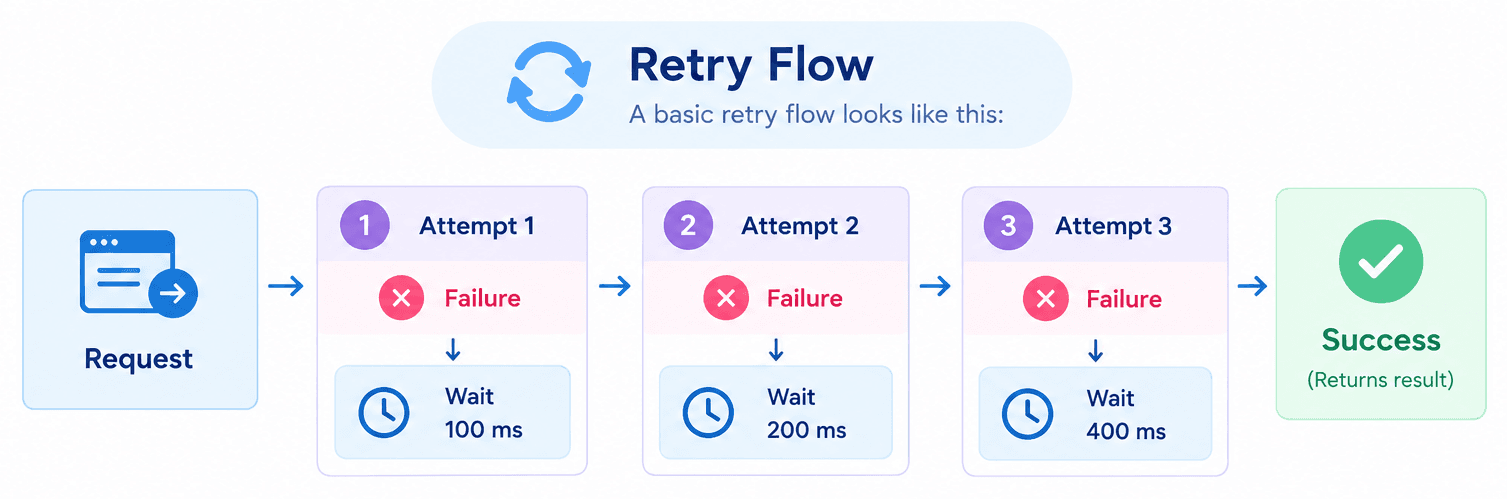
Retries can improve API reliability, but they should never be unlimited.
This is dangerous:
If a downstream service is already struggling, unlimited retries add more traffic, making the dependency slower and potentially dragging other services down with it.
This can result in a retry storm, sometimes described as a thundering herd.
The goal isn't to retry as much as possible.
It's to:
Retry only when retrying has a reasonable chance of helping.
3. Use Exponential Backoff and Jitter
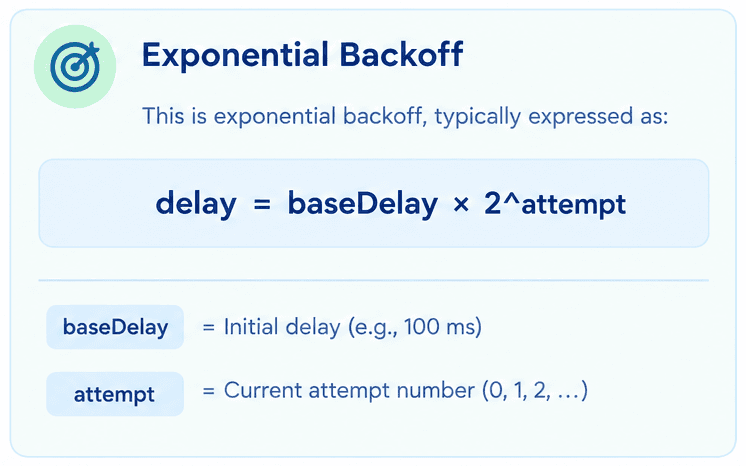
If a request fails, immediately sending another one may not give the dependency enough time to recover.
Instead, introduce a progressively longer delay between attempts:
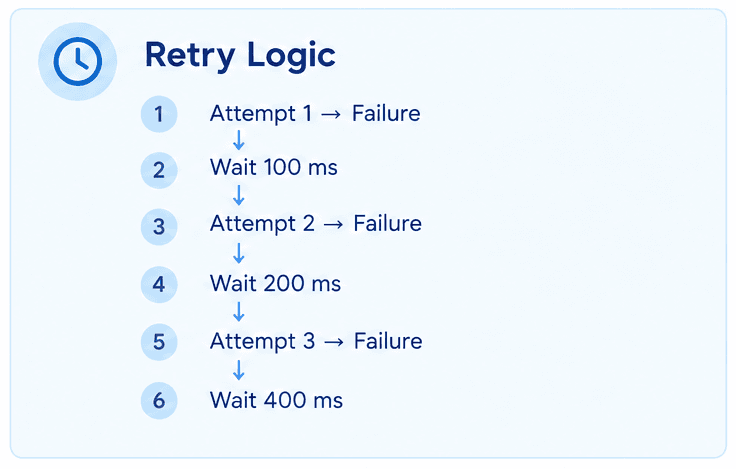
But backoff alone isn't always enough.
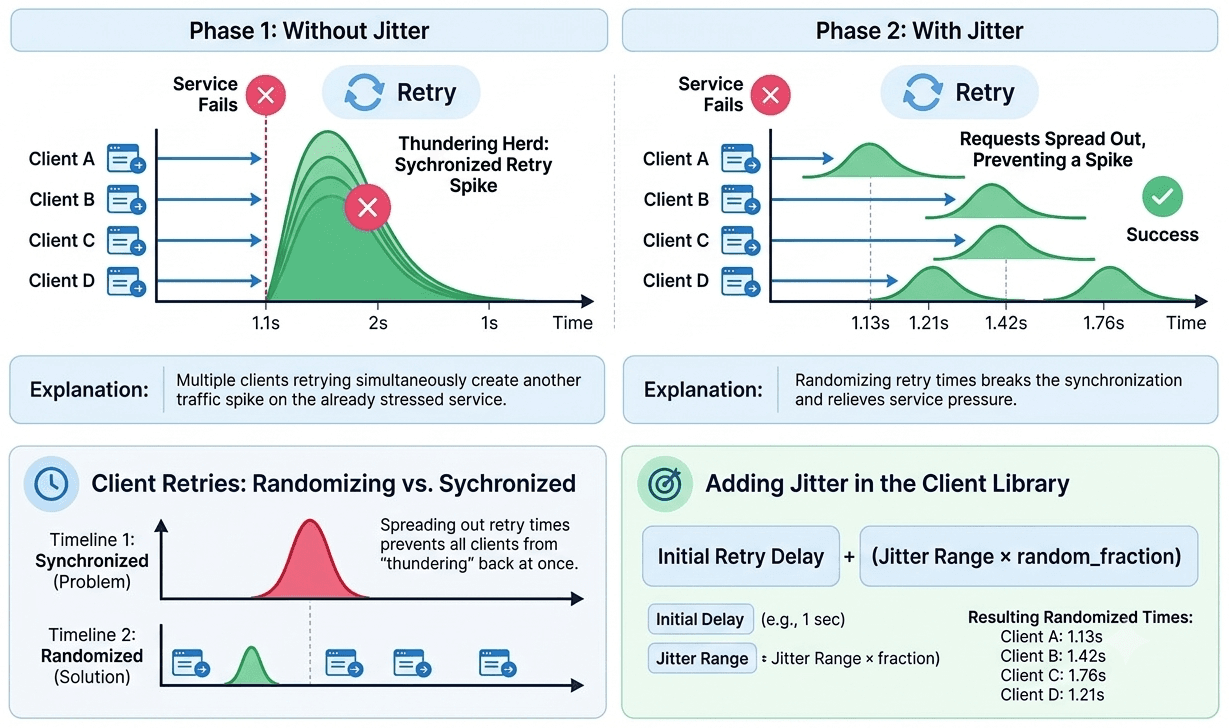
Picture thousands of clients hitting the same outage and following the exact same retry schedule - they could all retry at once:
Instead of relieving pressure, that retry wave creates another traffic spike.
This is where jitter helps - by randomizing retry times so they spread out instead of synchronizing:
A solid retry policy should define:
A. Maximum number of attempts
B. Maximum total retry duration
C. Backoff strategy
D. Jitter
E. Which errors are retryable
F. Which errors should fail immediately
A retry budget - capping the total retry traffic a service is allowed to generate, rather than evaluating each request in isolation - adds another layer of protection.
4. Don't Retry Every Failure
A common mistake is treating every error as temporary.
Take a 400 Bad Request - retrying it won't help. The request itself is invalid, and sending the same invalid request again changes nothing.
The same logic applies to most authentication and authorization failures: retrying them is unlikely to fix the underlying problem.
| Condition | Retry? |
|---|---|
| Network timeout | Usually |
| Temporary connection failure | Usually |
| 503 Service Unavailable | Often |
| 429 Too Many Requests | Based on server guidance |
| 400 Bad Request | No |
| 401 Unauthorized | Usually no |
| 403 Forbidden | No |
| Validation failure | No |
The exact policy will depend on your API contract and the operation in question, but the underlying question is always the same:
Is the failure likely to disappear without changing the request?
If yes, a retry can make sense. If no, fail fast and return a useful error.
5. Circuit Breakers: Stop Calling a Failing Dependency
Retries help when failures are temporary.
But what happens when a dependency is completely down?
Continuing to send and retry requests wastes resources on your side while adding pressure to a system that's already failing.
This is what the circuit breaker pattern helps solve.
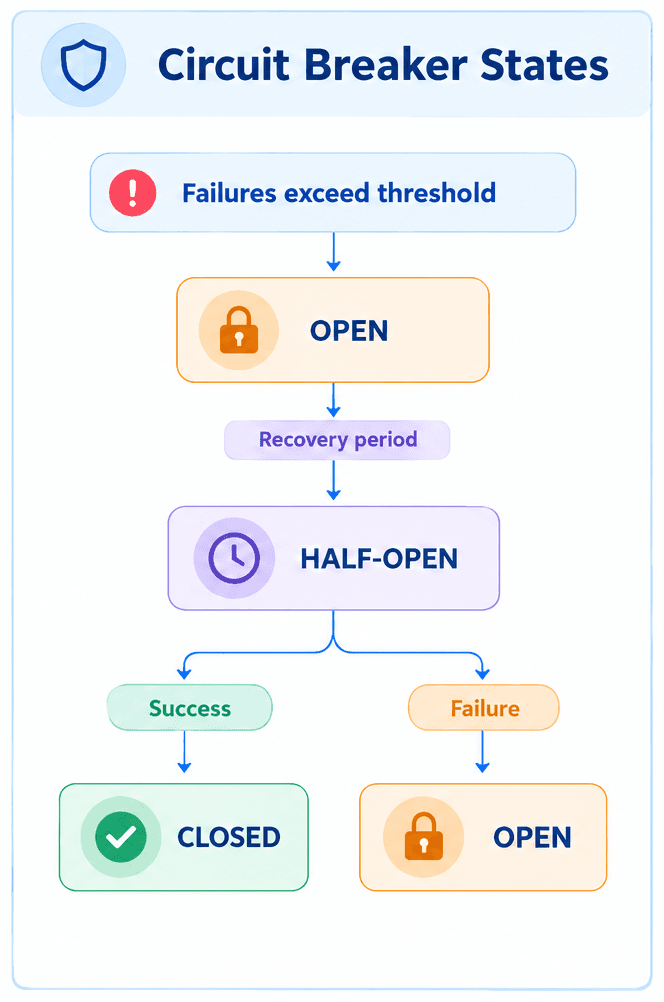
A circuit breaker typically has three states:
Closed
Requests flow normally while the breaker monitors for failures.
Open
The dependency is considered unhealthy, so requests fail fast instead of continuing to hit it.
Half-Open
After a recovery interval, a limited number of test requests are allowed through.
Success moves the breaker back to Closed. Failure sends it back to Open.
The idea is simple:
Stop repeatedly calling a dependency that's likely to fail.
This protects both your application and the struggling dependency.
6. Retry and Circuit Breakers Should Work Together
Retries and circuit breakers answer different questions.
Retry asks:"Could this temporary failure succeed if we try again?"
Circuit breaker asks:"Is this dependency failing badly enough that we should stop calling it?"
A resilient API can combine both:
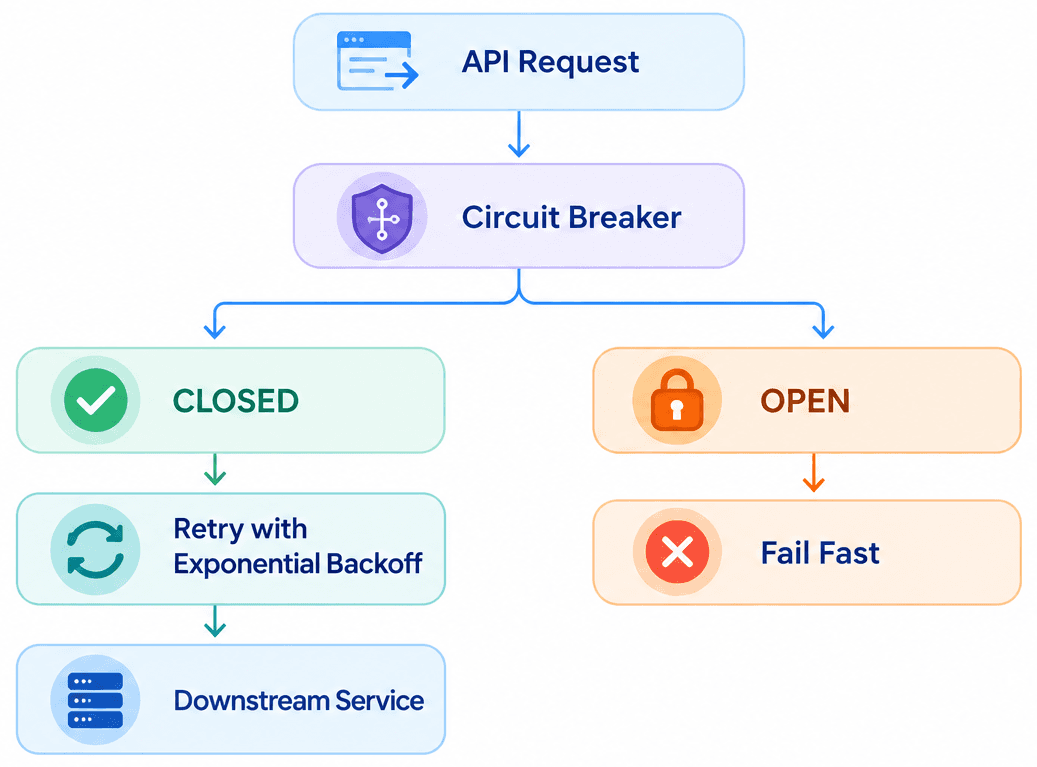
A typical flow is:
- Make the initial request.
- If a transient failure occurs, retry within limits.
- Apply exponential backoff and jitter
- If failures continue past a threshold, open the circuit.
- Reject subsequent calls quickly.
- After a recovery period, allow limited test traffic.
- Close the circuit if the dependency recovers.
The key is that retries shouldn't keep running once the circuit has signaled that the dependency is unhealthy.
Common API Failure-Handling Anti-Patterns
Even well-intentioned resilience mechanisms can backfire when implemented poorly.
1. Infinite retries
Keeps a struggling dependency under continuous pressure.
2. Immediate retries
Can cause multiple clients to synchronize and create another traffic spike.
3. No timeout
Allows an unavailable dependency to consume resources indefinitely.
4. Retrying every failure
Invalid requests and authentication or authorization failures usually won't be fixed by repeating the same request.
5. Meaningless circuit-breaker thresholds
Overly aggressive thresholds can cause unnecessary failures, while overly lenient thresholds may provide little protection.
6. No observability
Without visibility into retry counts, timeout rates, dependency latency, and circuit state, diagnosing resilience problems becomes guesswork.
A Practical API Resilience Checklist
Before shipping an API to production, ask:
Timeouts
- Does every external call have an explicit timeout?
- Are timeout values based on actual service requirements?
- Could a slow dependency exhaust application resources?
Retries
- Which failures are genuinely transient?
- Are retry attempts capped?
- Is exponential backoff implemented?
- Is jitter applied?
- Which errors should fail immediately?
Circuit Breakers
- Can unhealthy dependencies be isolated?
- Are the thresholds meaningful?
- Is there a recovery mechanism?
- Is circuit state observable?
These questions help turn API resilience from a theoretical concept into a deliberate part of production API design.
How Synoverge Can Help Build Resilient APIs
Resilient APIs require more than adding a retry mechanism. They require thoughtful architecture, reliable integrations, scalable infrastructure, testing, and an understanding of how applications behave when dependencies become slow or unavailable.
Synoverge works across product engineering, cloud, DevOps, verification and validation, and enterprise application development, helping organizations build and modernize scalable digital platforms.
For example, in our recent Synoverge case study, the Secure Document Vault (SDV) platform developed for a US-based specialty financial insurer, the client needed to replace a legacy document management environment with a secure, scalable platform capable of handling growing volumes of sensitive risk and underwriting documents.
Synoverge engineered a high-performance API layer using NestJS and GraphQL, optimized database queries for more than 3 million records, and built a cloud-native architecture using AWS S3 and PostgreSQL. The resulting platform achieved a 40% reduction in API response latency, 60% faster document retrieval, and a highly reliable, modular foundation for future growth.
This example highlights an important principle of resilient API design: reliability isn't created by a single mechanism. It comes from combining efficient API architecture, scalable infrastructure, optimized data access, and thoughtful system design.
For organizations building or modernizing API-driven applications, Synoverge can help incorporate these principles across the broader engineering lifecycle, from architecture and integration to development, testing, and production readiness.
The objective is not simply to make an API work when everything is healthy.
It's to build systems that can continue handling real-world failures in a controlled way.
Conclusion
API resilience isn't a feature you bolt on after the fact. It's a set of engineering decisions built around one goal:
One failure should not become a system-wide failure.
Timeouts prevent indefinite waiting.
Retries recover from transient failures.
Exponential backoff and jitter help prevent retry storms.
Circuit breakers stop applications from repeatedly calling unhealthy dependencies.
These mechanisms work together rather than in isolation.
A resilient API should be able to answer two questions clearly:
What happens when a dependency is slow?
What happens when a dependency fails?
If those scenarios have been deliberately designed for, tested, observed, and measured, the API is far more likely to hold up when real-world conditions stop being ideal.
Distributed systems will fail. Networks will slow down. Dependencies will become unavailable. Servers will crash.
Resilience isn't about pretending these things won't happen.
It's about designing the system so that when they do, the failure stays contained, recovery remains possible, and the most important functionality keeps working.
Failure is part of the architecture, and resilient APIs are designed with that assumption from the start.
Frequently Asked Questions (FAQs)
API resilience is the ability of an API to handle slow, unavailable, or failing dependencies while limiting the impact on the overall system.
Start with explicit timeouts, controlled retries, exponential backoff, jitter, appropriate retry policies, and circuit breakers. These mechanisms should be designed around the behavior of the API's dependencies.
An API should generally retry when the failure is likely to be temporary and the operation can be safely repeated. Permanent errors such as invalid requests generally should not be retried.
Exponential backoff progressively increases the delay between retry attempts. Jitter adds controlled randomness to those delays so multiple clients don't retry at exactly the same time.
A circuit breaker temporarily stops requests to an unhealthy dependency after failures reach a defined threshold. It can later test whether the dependency has recovered before allowing normal traffic again.
Timeouts prevent an API from waiting indefinitely for a slow or unavailable dependency. They help protect application resources and allow the system to handle failures in a controlled way.
Cascading failures can occur when one dependency becomes slow or unavailable and the calling API continues waiting for it. As more requests arrive, resources such as connections and workers can become exhausted, causing the problem to spread to other parts of the system.
A retry storm occurs when multiple clients or services repeatedly retry failed requests, generating additional traffic while a dependency is already struggling. Exponential backoff and jitter can help reduce this additional pressure.
No. Retries are generally appropriate for failures that may be temporary, such as certain network failures, timeouts, or 503 Service Unavailable responses. Errors such as invalid requests, validation failures, and most authorization failures usually should not be retried.
Retries give temporary failures another opportunity to succeed, while circuit breakers stop requests when a dependency continues to fail. Used together, they can help recover from transient problems while preventing an unhealthy dependency from causing further system-wide impact.
Table of Contents


Is Your API Architecture Built for Resilience?
Let our experts help you design reliable APIs.
Contact UsRelated Blogs

Software Development
How to Select a Software Partner That Delivers
By Ritesh Dave February 14, 2025
For ISVs, Independent Software Consultants, and SMEs, selecting the right software development partner is critical for growth, innovation, and gaining a competitive edge. Partnering with the ideal development team can even yield cost savings of 60-70% on web development projects.


Software Development, Artificial Intelligence
AI Orchestration for Legacy System Modernization: A Complete Guide
By Ritesh Dave 31 Aug, 2026
Discover how AI orchestration accelerates legacy system modernization through intelligent automation, code transformation, and cloud-driven innovation.

Software Development, Artificial Intelligence
Guide to SharePoint Syntex - Best Practices & Real-World Use Cases
By Vishwas Goswami May 12, 2025
Learn about SharePoint Syntex, real-world use cases, best practices for implementations, and how it will be helpful in improving productivity.